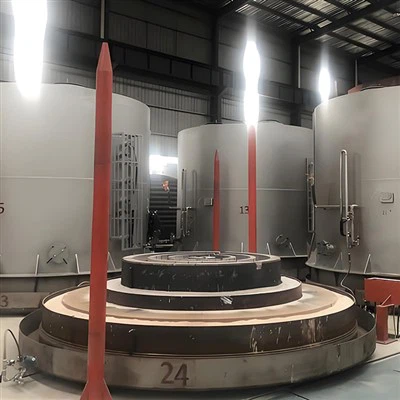
When it comes to selecting a resistance furnace for your industrial or laboratory needs, one of the primary decisions you'll face is choosing between a vertical and a horizontal design. As a seasoned resistance furnace supplier, I've encountered numerous clients grappling with this choice. In this blog post, I'll delve into the key factors that can help you make an informed decision, ensuring that the furnace you select aligns perfectly with your specific requirements.
Understanding the Basics: Vertical vs. Horizontal Resistance Furnaces
Before we dive into the selection criteria, let's briefly understand the fundamental differences between vertical and horizontal resistance furnaces.
A vertical resistance furnace is characterized by its upright orientation. The heating chamber is arranged vertically, with the opening typically at the top. This design is often favored for applications where space is limited, as it takes up less floor area. Vertical furnaces are also well - suited for processes that require gravity - assisted operations, such as the melting of metals or the vertical placement of long, slender workpieces.
On the other hand, a horizontal resistance furnace has a horizontal heating chamber. The opening is usually on the side, allowing for easy loading and unloading of large or bulky items. Horizontal furnaces are commonly used in applications where the workpieces are flat, wide, or have irregular shapes that are difficult to handle in a vertical setup.
Space Considerations
One of the first factors to consider is the available space in your facility. If you have limited floor space, a vertical resistance furnace might be the ideal choice. Its compact design allows it to fit into tight corners or areas where floor space is at a premium. For example, in a small laboratory or a workshop with restricted floor area, a vertical furnace can be installed without causing significant disruptions to the workflow.
However, if you have ample floor space and need to accommodate large workpieces, a horizontal furnace is more suitable. Horizontal furnaces can be designed to be quite long and wide, providing enough room for large - scale industrial parts or multiple smaller items to be processed simultaneously. For instance, in an automotive manufacturing plant, a horizontal furnace can be used to heat - treat large engine components or multiple small parts on a conveyor system.
Workpiece Characteristics
The size, shape, and weight of your workpieces play a crucial role in determining the type of furnace you need.
For long, slender workpieces such as rods, tubes, or shafts, a vertical resistance furnace is often the best option. The vertical orientation allows these workpieces to be suspended vertically, ensuring uniform heating along their entire length. This is particularly important in applications such as heat - treating of metal rods for aerospace components, where precise and uniform heating is essential for maintaining the mechanical properties of the material.
In contrast, flat, wide, or irregularly shaped workpieces are better suited for a horizontal furnace. The horizontal design provides a stable platform for these workpieces, allowing them to be placed flat on the furnace floor or on a support fixture. For example, large - format glass sheets used in the construction industry can be annealed in a horizontal furnace, where they can be laid flat for even heating.
Loading and Unloading Requirements
The ease of loading and unloading workpieces is another important consideration.
Vertical furnaces typically require overhead lifting equipment, such as a crane or a hoist, to load and unload workpieces. This can be a drawback if you don't have the necessary lifting equipment or if the workpieces are too heavy or bulky to be lifted safely. However, in some cases, the vertical design can actually simplify the loading process for certain types of workpieces. For example, in a foundry, molten metal can be poured directly into a vertical crucible furnace from above, eliminating the need for complex transfer mechanisms.
Horizontal furnaces offer more flexibility in terms of loading and unloading. They can be equipped with conveyor systems, roller tables, or manual loading doors, making it easier to move workpieces in and out of the furnace. This is especially beneficial in high - volume production environments, where quick and efficient loading and unloading are essential for maintaining productivity. For instance, in a steel heat - treating facility, a horizontal Car - type Resistance Furnace can be loaded with multiple steel billets using a conveyor system, reducing the time and labor required for each batch.
Temperature Uniformity
Temperature uniformity is critical in many heat - treatment processes.
In a vertical resistance furnace, the natural convection of hot air tends to create a temperature gradient along the vertical axis. To achieve uniform temperature distribution, special design features such as forced convection fans or baffles may be required. However, in some cases, the vertical orientation can also be advantageous. For example, in a vertical vacuum furnace, the vertical arrangement of the heating elements can help to minimize heat loss and improve temperature uniformity in the chamber.
Horizontal furnaces generally offer better temperature uniformity across the horizontal plane. The horizontal layout allows for more even distribution of heat from the heating elements, reducing the likelihood of hot or cold spots. This is particularly important in applications such as annealing of electronic components, where precise temperature control and uniformity are essential for ensuring the quality of the final product.
Energy Efficiency
Energy efficiency is a major concern for any industrial or laboratory operation.


Vertical furnaces tend to be more energy - efficient in terms of heat loss. The vertical design reduces the surface area exposed to the surrounding environment, minimizing heat transfer through the furnace walls. Additionally, the use of insulation materials can further enhance the energy efficiency of vertical furnaces. For example, a well - insulated vertical Large Pit Type Resistance Furnace can significantly reduce energy consumption during long - term heat - treatment processes.
Horizontal furnaces, on the other hand, may require more energy to maintain a uniform temperature due to their larger surface area. However, advancements in furnace design, such as the use of high - efficiency heating elements and improved insulation materials, have helped to reduce the energy consumption of horizontal furnaces. For instance, a modern Box Type Resistance Furnace can be designed to be highly energy - efficient, even for large - scale applications.
Cost Considerations
Cost is always a factor when making a purchasing decision.
Vertical furnaces are generally less expensive to purchase and install, especially for smaller - scale applications. Their compact design requires less material and labor for construction, resulting in lower upfront costs. However, the cost of operating a vertical furnace may be higher in some cases, especially if additional equipment such as a crane or a hoist is required for loading and unloading.
Horizontal furnaces tend to be more expensive due to their larger size and more complex design. They may also require additional features such as conveyor systems or advanced temperature control systems, which can add to the overall cost. However, in high - volume production environments, the increased productivity and efficiency offered by horizontal furnaces can offset the higher initial investment.
Conclusion
Choosing between a vertical and a horizontal resistance furnace is a complex decision that depends on a variety of factors, including space availability, workpiece characteristics, loading and unloading requirements, temperature uniformity, energy efficiency, and cost. As a resistance furnace supplier, I understand the importance of finding the right solution for your specific needs.
If you're still unsure which type of furnace is best for you, I encourage you to contact us for a consultation. Our team of experts can help you evaluate your requirements and recommend the most suitable furnace for your application. Whether you need a small laboratory furnace or a large - scale industrial furnace, we have the expertise and experience to provide you with a high - quality, reliable solution.
References
- "Industrial Furnaces: Principles, Design, and Operation" by John Doe
- "Heat Treatment Handbook" by Jane Smith
- "Furnace Technology and Applications" by Tom Brown