


Cycle Operation Furnace
Jiuding Industrial Furnace:Your Professional Cycle Operation Furnace Manufacturer!
Jiangsu Jiuding industrial furnace technology Co., Ltd., is a young enterprise with unique ideas about the design and manufacture of industrial furnaces and heat treatment furnace. Our company is located in jiangsu danyang yellow Nian bridge economic industrial park. Company site management implementation by 8 s standard, the product with scientific design, materials, quality assurance, manufacturing details rein to coordinate, implement welding, assembly, heat preservation, the control standard, coating, uniform temperature field, this is the dominant industrial furnace is ongoing. It is absolutely necessary to provide customers with every equipment manufacturing heart, use the rest assured.



Why Choose Us
Our Factory
Jiuding have more than 90 staff and workers, and more than 60% are professional and technical personnel, in which, 1 senior engineer, 3 engineers, 5 assistant engineers and 15 technicians. Now, Jiuding have implement the 6S and ISO9001 management system comprehensively and this also lay the foundation for our company becoming the leader of furnace industry.
Product Application
Our products are widely used in heavy industry fields such as smelting, casting, forging, shipbuilding, chemical equipment manufacturing, hydropower equipment manufacturing, thermal power equipment manufacturing, nuclear power equipment manufacturing, and high-strength fastener manufacturing.
Advanced Equipment
Our company has a full range of conventional industrial furnace manufacturing equipment, and CNC plasma cutting machine, the United States fluke laser detector temperature field, wind pressure, wind speed measuring instrument, gas pressure tester, gas concentration detection alarming device, infrared thermometer.
Production Market
So far, Jiuding brand have been affirmed by all our customers and currently our sales network have reached all over the world, include: Russia, South Africa, Turkey, Saudi Arabia, UAE, Iran, India, Pakistan, Indonesia, Vietnam, Taiwan, Central Asia, etc.
Types of Cycle Operation Furnace
The cycle operation furnace produced by our company mainly include the following types:
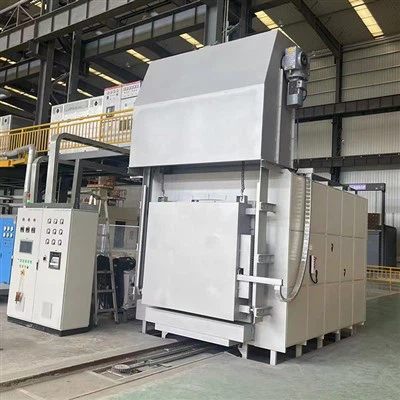
Box Type Furnace
The Box type furnace is mainly used for alloy steel products, various molds normalizing, quenching, annealing and other heat treatments, or diamond saw blades for high-temperature sintering. Stainless steel nitrogen inlet pipes and valves are installed on the side of the furnace to adjust the air intake, which can play a simple protective atmosphere role and reduce the oxidation of workpieces.
|
Parameter name |
Unit |
Model |
|||||
|
RX3-30-12 |
RX3-45-12 |
RX3-65-12 |
RX3-90-12 |
RX3-115-12 |
|||
|
Rated Power |
KW |
30 |
45 |
65 |
90 |
115 |
|
|
Rated voltage |
V |
380 |
|||||
|
Rated Temp. |
℃ |
1200 |
|||||
|
Operating Temp. |
℃ |
1100 |
|||||
|
Number of phases |
Phase |
33333 |
|||||
|
Furnace size |
Diameter |
mm |
800 |
950 |
1200 |
1500 |
1800 |
|
Width |
mm |
400 |
450 |
600 |
750 |
900 |
|
|
High |
mm |
350 |
350 |
400 |
450 |
500 |
|
|
Heating element connection |
|
Y |
|||||
|
Empty furnace heating time |
H |
2 |
2.5 |
3 |
3 |
4 |
|
|
Temperature control accuracy |
℃ |
±1 |
|||||
|
Max. load capacity |
Kg |
150 |
200 |
400 |
850 |
1600 |
|
|
Weight |
Kg |
2000 |
2300 |
2800 |
3600 |
4500 |
|
Crucible Furnace
A crucible furnace is a type of furnace, often used in foundries, that utilizes a crucible to melt metals. The crucible, a heat-resistant container made of materials like graphite, clay, or ceramic, holds the metal and any additives during the heating process. These furnaces are commonly used for melting metals with lower melting points, such as brass, bronze, and aluminum.
|
Model |
Rated Power (KW) |
Rated voltage (V) |
Number of phases |
Work area size (mm) |
Max. load capacity (kg) |
Weight (kg) |
|
GR2-40 |
20 |
380 |
3 |
ф280×430 |
40(Al) |
1000 |
|
GR2-150 |
60 |
380 |
3 |
ф460×600 |
150 |
1300 |
|
GR2-270 |
75 |
380 |
3 |
ф460×870 |
270 |
1700 |
Versatility in Workpiece Accommodation:
One of the key advantages of a box type furnace is its ability to accommodate workpieces of various shapes and sizes. This flexibility makes it a preferred choice for industries dealing with diverse components.
The furnace's interior chamber can be customized with shelves, trays, or fixtures to optimize space and ensure even heat distribution.
Wide Temperature Range:
Box type furnaces can operate across a broad temperature spectrum, typically ranging from 100°C to 1700°C, depending on the model and heating elements used.
This wide range allows the furnace to support multiple heat treatment processes, including low-temperature tempering and high-temperature sintering.
Ease of Operation and Low Maintenance:
Box type furnaces are designed for user-friendly operation, often featuring programmable controllers for precise temperature and time settings.
Their robust construction and simple design contribute to low maintenance requirements, reducing downtime and operational costs.


Batch Processing Capability:
Box type furnaces are commonly used for batch processing, where a group of components is treated simultaneously. This method is ideal for low-volume production or specialized heat treatments.
Each batch can be tailored to specific requirements, such as varying weights, sizes, or material grades.
Versatility:
The box type furnace's versatility makes it suitable for a wide range of applications, from industrial manufacturing to academic research. Its ability to handle different materials and processes makes it an essential tool in many fields.
Application of Box Type Furnace
Heat Treatment Processes:
A box type furnace is designed to provide a controlled heating environment for a variety of industrial and scientific applications. Its primary purpose is to facilitate heat treatment processes, which are essential in altering the physical and sometimes chemical properties of materials.
Sintering of Metal Powders:
Sintering is a process where metal powders are heated to a temperature below their melting point, causing the particles to bond together. This is crucial in powder metallurgy for creating solid metal components.
Alloy Melting:
The box type furnace is also used for melting alloys, which involves heating metal mixtures to a liquid state to create new materials with specific properties.
Electronic Component Manufacturing:
In the electronics industry, box type furnaces are used for processes such as brazing, where metal parts are joined using a filler metal, and for the heat treatment of electronic components to improve their performance and durability.
Scientific Research:
Universities and research institutions utilize box type furnaces for various scientific experiments that require precise and controlled heating conditions. This includes materials science research, where the effects of heat on different materials are studied.
Advantages of Crucible Furnace
Ease of Operation and Maintenance
Crucible furnaces are designed for simplicity, requiring minimal technical expertise to operate.Maintenance is straightforward, reducing downtime and operational costs.This makes them suitable for small foundries or facilities with limited technical staff.
Versatility in Melting Alloys
Crucible furnaces can handle a wide range of alloys, from non-ferrous metals like aluminum and copper to precious metals like gold and silver.There are practically no limitations on the type of alloy, providing flexibility for diverse applications.
Small Batch Capability
These furnaces are ideal for melting small quantities of material, which is beneficial for research, prototyping, or custom manufacturing.The ability to process small batches reduces material waste and allows for precise control over production.
High Purity and Uniformity
While not as advanced as CVD furnaces, crucible furnaces still offer good purity levels for many applications.The design ensures even heat distribution, leading to consistent melting and alloy homogeneity.
Scalability
Crucible furnaces can be scaled up or down depending on production needs, making them adaptable to both small-scale and medium-scale operations.This scalability is particularly useful for growing businesses or facilities with fluctuating production demands.
Material Compatibility
The use of graphite crucibles enhances durability and resistance to high temperatures, making them suitable for melting a variety of materials.Graphite crucibles also resist chemical reactions with molten metals, ensuring cleaner melts.
Energy Efficiency
Crucible furnaces are generally energy-efficient, especially when used for small batches, as they require less energy to reach and maintain operating temperatures.
Quick Setup and Mobility
Crucible furnaces can be quickly set up and relocated if needed, providing operational flexibility.This is advantageous for temporary or mobile foundries.
Metal processing industry
Precious metal smelting: High purity, low pollution, suitable for jewelry processing and recycling.
Alloy preparation: Achieving uniform alloy composition and improving material properties through precise temperature control.
Ceramic and New Materials Field
Ceramic sintering: Achieving ceramic densification at high temperatures, improving mechanical strength and electrical properties.
Nanomaterial synthesis: Prepare high-purity nano powder in inert gas or vacuum environment.
Laboratory research
Material analysis: Used for experiments such as thermogravimetric analysis (TGA) and differential scanning calorimetry (DSC).
New process development: Supports small-scale trial production and rapid verification of material properties.
Industrial production
Large scale melting: Suitable for large-scale production scenarios such as casting and powder metallurgy.
Energy saving and consumption reducing: Efficient heat transfer and insulation design reduce energy consumption and enhance economic benefits.

Packaging and Shipping
Trucking: For local or short-distance shipments, a flatbed truck is typically used. Use heavy-duty strapping or chains to secure the stove to the truck bed. Ensure the strapping is properly tightened and has no slack. Place padding between the stove and the truck bed to prevent scratches and damage.
Containerizing: For long-distance or overseas shipments, use a container. Inside the container, use wooden blocks or brackets to support the stove and prevent it from moving.
Our certificates
