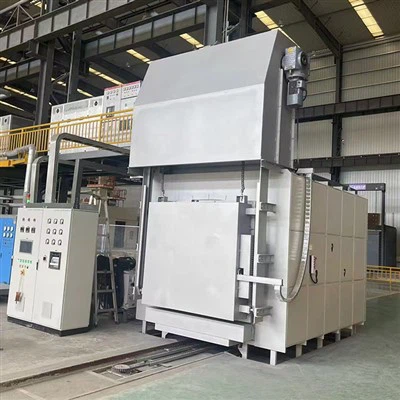
As a resistance furnace supplier, understanding the detection methods for temperature distribution in a resistance furnace is crucial. This knowledge not only helps us ensure the quality and performance of our products but also enables us to provide better solutions to our customers. In this blog, we will explore various detection methods for temperature distribution in a resistance furnace.


Importance of Temperature Distribution Detection
Temperature distribution in a resistance furnace directly affects the quality of the heat treatment process. Uneven temperature distribution can lead to inconsistent product quality, such as uneven hardness, distortion, and cracking. Therefore, accurate detection of temperature distribution is essential for achieving high - quality heat treatment results.
Thermocouples
Thermocouples are one of the most commonly used temperature sensors in resistance furnaces. They work based on the Seebeck effect, where a voltage is generated at the junction of two different metals when there is a temperature difference.
How Thermocouples are Used
Multiple thermocouples can be placed at different positions inside the resistance furnace. For example, in a Large Pit Type Resistance Furnace, thermocouples can be installed at the top, middle, and bottom of the pit to measure the temperature at different heights. The data from these thermocouples can be collected and analyzed to understand the temperature distribution.
Advantages and Disadvantages
The advantages of thermocouples include wide temperature measurement range, relatively low cost, and fast response time. However, they also have some limitations. For instance, the accuracy of thermocouples can be affected by factors such as the type of metal used, the installation position, and the presence of electromagnetic interference.
Infrared Thermometers
Infrared thermometers measure the temperature of an object by detecting the infrared radiation emitted by it. They are non - contact temperature measurement devices, which means they can measure the temperature of an object without physically touching it.
Application in Resistance Furnaces
In a Box Type Resistance Furnace, infrared thermometers can be used to measure the surface temperature of the workpiece or the inner wall of the furnace. They can provide a quick and convenient way to get an overview of the temperature distribution.
Advantages and Disadvantages
The main advantage of infrared thermometers is their non - contact nature, which allows for measurement without disturbing the heat treatment process. They also have a fast response time. However, their accuracy can be affected by factors such as the emissivity of the object being measured, the distance between the thermometer and the object, and the presence of dust or smoke in the furnace.
Thermal Imaging Cameras
Thermal imaging cameras are capable of capturing a two - dimensional image of the temperature distribution in a resistance furnace. They work by detecting the infrared radiation emitted by objects and converting it into a visible image, where different colors represent different temperatures.
Use in Resistance Furnaces
In a Car - type Resistance Furnace, thermal imaging cameras can be used to monitor the temperature distribution across the entire car and the workpiece on it. This provides a comprehensive view of the temperature distribution, which can help in identifying hot spots and cold spots.
Advantages and Disadvantages
The advantage of thermal imaging cameras is that they can provide a visual representation of the temperature distribution, which is very intuitive. They can also cover a large area at once. However, they are relatively expensive, and their accuracy can be affected by factors such as the camera's calibration and the environmental conditions.
Temperature - Sensitive Paints
Temperature - sensitive paints are special paints that change color with temperature. They can be applied to the surface of the workpiece or the inner wall of the resistance furnace.
How They Work
When the temperature changes, the color of the paint changes accordingly. By observing the color change, we can get an idea of the temperature distribution. For example, in a small - scale resistance furnace, temperature - sensitive paints can be used to quickly assess the temperature distribution on the surface of a small workpiece.
Advantages and Disadvantages
The advantage of temperature - sensitive paints is their simplicity and low cost. They can provide a qualitative understanding of the temperature distribution. However, they are not very accurate for quantitative measurement, and the color change may be affected by factors such as the thickness of the paint and the viewing angle.
Wireless Temperature Sensors
Wireless temperature sensors are a new type of temperature measurement device. They can transmit temperature data wirelessly to a receiver, which makes it convenient to collect and analyze the data.
Application in Resistance Furnaces
In a large - scale resistance furnace, wireless temperature sensors can be placed at multiple locations inside the furnace. They can continuously monitor the temperature and transmit the data in real - time, which is very useful for long - term temperature distribution monitoring.
Advantages and Disadvantages
The advantage of wireless temperature sensors is their flexibility and convenience. They can be easily installed and moved around. However, their performance can be affected by factors such as the wireless signal strength and the battery life.
Conclusion
In conclusion, there are several methods for detecting temperature distribution in a resistance furnace, each with its own advantages and disadvantages. As a resistance furnace supplier, we need to choose the appropriate detection method based on the specific requirements of the furnace and the heat treatment process. By accurately detecting the temperature distribution, we can ensure the quality and performance of our resistance furnaces, and provide better services to our customers.
If you are interested in our resistance furnaces and would like to discuss the temperature distribution detection methods further or have any procurement needs, please feel free to contact us. We are looking forward to working with you to achieve your heat treatment goals.
References
- "Heat Treatment Furnaces: Principles and Applications" by John Doe
- "Temperature Measurement Techniques in Industrial Furnaces" by Jane Smith