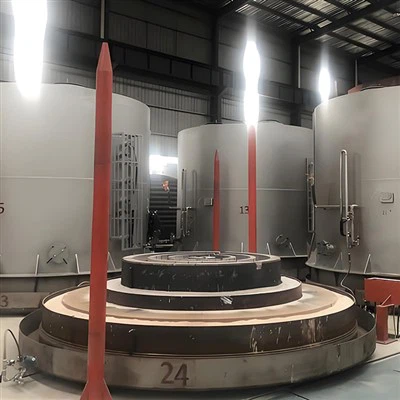
Hey there! As a supplier of Mold Roasting Furnaces, I've been getting a lot of questions about the temperature distribution inside these bad boys. So, I thought I'd take a deep dive into this topic and share what I've learned over the years.
First off, let's talk about why temperature distribution matters in a Mold Roasting Furnace. You see, a uniform temperature distribution is crucial for ensuring that the molds are roasted evenly. If the temperature varies too much within the furnace, some parts of the mold might not get roasted properly, while others could get over - roasted. This can lead to defects in the final product, such as uneven hardness, cracking, or poor dimensional accuracy.
There are several factors that can affect the temperature distribution inside a Mold Roasting Furnace. One of the most significant factors is the design of the furnace itself. For example, the type of heating elements used, their placement, and the way the furnace is insulated all play a role.
Let's start with the heating elements. Most Mold Roasting Furnaces use either electric heating elements or gas burners. Electric heating elements are known for their precise temperature control. They can be placed strategically around the furnace chamber to provide a more even heat distribution. For instance, you might have elements on the sides, top, and bottom of the chamber. This multi - directional heating helps to reduce temperature gradients within the furnace.
On the other hand, gas burners can provide a large amount of heat quickly. However, they can also create hot spots if not properly designed and installed. To mitigate this, modern gas - fired Mold Roasting Furnaces often use advanced burner designs and combustion control systems. These systems help to distribute the heat more evenly throughout the furnace.
The insulation of the furnace is another critical factor. Good insulation helps to retain the heat inside the furnace and prevents heat loss to the surroundings. A well - insulated furnace will have a more stable temperature distribution because there is less heat escaping from the sides, top, and bottom. There are different types of insulation materials available, such as ceramic fiber and refractory bricks. Ceramic fiber insulation is lightweight and has excellent thermal insulation properties. It can be easily installed in the furnace walls and ceiling, providing a tight seal to keep the heat in.
The shape and size of the furnace chamber also impact temperature distribution. A larger chamber might have more difficulty achieving a uniform temperature compared to a smaller one. This is because heat has to travel further to reach all parts of the chamber. To address this, some furnaces use fans or blowers to circulate the hot air inside the chamber. The forced air circulation helps to mix the hot and cold air, reducing temperature differences.
Now, let's take a look at some of the different types of Mold Roasting Furnaces we offer. We have the Box Type Shell Baking Furnace. This type of furnace is ideal for small to medium - sized molds. It has a compact design, which makes it easier to achieve a relatively uniform temperature distribution. The box shape allows for a more straightforward placement of heating elements and insulation, ensuring that the heat is evenly distributed throughout the chamber.


Our Box Type Roasting Furnace is similar to the shell baking furnace but is designed for a wider range of mold sizes. It has a more robust heating system and better insulation, which helps to maintain a consistent temperature distribution even when roasting larger molds.
For larger - scale operations, we offer the Trolley Type Roasting Furnace. This furnace is designed to handle large and heavy molds. It has a trolley that can be loaded with the molds and then rolled into the furnace chamber. The design of the trolley type furnace allows for easy loading and unloading of the molds. To ensure a uniform temperature distribution, it uses a combination of multiple heating elements and forced air circulation. The forced air helps to reach all parts of the large chamber and reduces temperature variations.
Measuring the temperature distribution inside a Mold Roasting Furnace is also an important aspect. We use thermocouples and temperature sensors placed at different locations inside the furnace chamber. These sensors continuously monitor the temperature and send the data to a control system. The control system can then adjust the heating elements or burners to maintain the desired temperature distribution.
In addition to the hardware, software also plays a role in temperature control. Advanced furnace control systems use algorithms to analyze the temperature data and make real - time adjustments. For example, if the sensors detect a hot spot in one area of the furnace, the control system can reduce the power to the nearby heating elements or increase the air circulation in that area.
Another factor that can affect temperature distribution is the loading pattern of the molds inside the furnace. If the molds are not loaded properly, they can block the flow of hot air and create temperature differences. It's important to follow the recommended loading guidelines to ensure that the heat can circulate freely around the molds.
To sum it up, achieving a uniform temperature distribution inside a Mold Roasting Furnace is a complex but achievable goal. It requires a combination of proper furnace design, high - quality insulation, advanced heating and control systems, and correct loading practices.
If you're in the market for a Mold Roasting Furnace and want to learn more about how we can ensure a great temperature distribution for your specific needs, don't hesitate to reach out. We're here to help you make the right choice and get the best results for your mold roasting processes.
References
- "Industrial Furnace Handbook: Principles, Design, and Operation"
- "Heat Transfer in Furnaces"