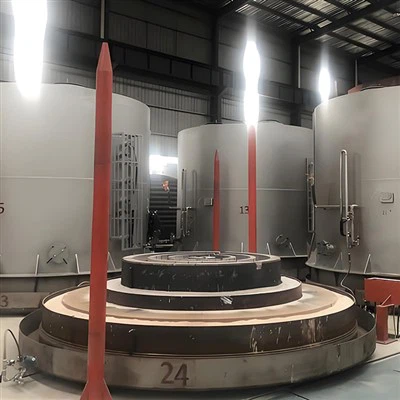
Carburizing is a crucial heat treatment process used to enhance the surface hardness and wear resistance of steel components. Various types of carburizing furnaces are available in the market, each with its unique features and applications. As a supplier of Carburizing Pit Furnace, I have witnessed firsthand the distinct advantages and differences of carburizing pit furnaces compared to other types of carburizing furnaces. In this blog post, I will delve into the characteristics of carburizing pit furnaces and highlight how they stand out from their counterparts.
Structural Design
One of the most noticeable differences between a carburizing pit furnace and other types of carburizing furnaces lies in its structural design. A carburizing pit furnace is typically installed vertically, with the heating chamber located below the floor level. This design allows for easy loading and unloading of heavy workpieces using overhead cranes or hoists. In contrast, box-type gas carburizing furnaces, such as the Box Type Gas Carburizing Furnace, have a horizontal configuration, which may require more floor space and specialized handling equipment for large or heavy parts.
The vertical design of a carburizing pit furnace also provides better heat distribution and uniformity. The hot gases rise naturally within the furnace chamber, ensuring that the workpieces are evenly heated from all sides. This results in a more consistent carburizing process and better quality control. Additionally, the pit design helps to minimize heat loss through the furnace walls, improving energy efficiency and reducing operating costs.
Loading Capacity and Flexibility
Carburizing pit furnaces are known for their large loading capacity, making them suitable for processing large or heavy workpieces. The vertical orientation of the furnace allows for the stacking of multiple layers of workpieces, maximizing the use of available space. This is particularly advantageous for industries that require high-volume production or the treatment of large components, such as automotive, aerospace, and heavy machinery.
In addition to their high loading capacity, carburizing pit furnaces offer greater flexibility in terms of workpiece size and shape. The open-top design of the furnace allows for easy access to the heating chamber, making it possible to accommodate irregularly shaped or oversized parts. This flexibility is not always available with other types of carburizing furnaces, which may have more limited loading options.
Process Control and Automation
Modern carburizing pit furnaces are equipped with advanced process control systems that allow for precise regulation of temperature, gas flow, and carburizing time. These systems use sensors and controllers to monitor and adjust the process parameters in real-time, ensuring consistent and repeatable results. The ability to control the carburizing process with high precision is essential for achieving the desired surface hardness and carbon concentration in the workpieces.
Automation is another key feature of carburizing pit furnaces. Many modern furnaces are equipped with automated loading and unloading systems, which can significantly improve productivity and reduce labor costs. These systems can be integrated with other manufacturing processes, such as machining and assembly, to create a seamless production line.
Gas Atmosphere and Carburizing Efficiency
The gas atmosphere used in a carburizing furnace plays a crucial role in the carburizing process. Carburizing pit furnaces typically use a mixture of hydrocarbon gases, such as methane or propane, to create a carbon-rich atmosphere. This atmosphere allows for the diffusion of carbon atoms into the surface of the steel workpieces, increasing their hardness and wear resistance.
The design of a carburizing pit furnace is optimized for efficient gas circulation and distribution. The vertical configuration of the furnace allows for the natural convection of the hot gases, ensuring that the workpieces are exposed to a uniform carbon-rich atmosphere. This results in a more efficient carburizing process and shorter processing times compared to other types of furnaces.
Maintenance and Durability
Carburizing pit furnaces are designed to be robust and durable, with a long service life. The furnace chamber is typically lined with high-quality refractory materials, which can withstand high temperatures and corrosive gases. The heating elements are also designed to be long-lasting and easy to replace, minimizing downtime and maintenance costs.


Regular maintenance is essential for ensuring the optimal performance and longevity of a carburizing pit furnace. However, the design of the furnace makes it relatively easy to access and maintain the internal components. The open-top design allows for easy inspection and cleaning of the furnace chamber, while the modular construction of the heating elements and control systems makes it possible to replace individual components without having to shut down the entire furnace.
Conclusion
In conclusion, carburizing pit furnaces offer several distinct advantages over other types of carburizing furnaces. Their unique structural design, large loading capacity, flexibility, advanced process control, and efficient gas atmosphere make them an ideal choice for a wide range of industrial applications. Whether you are looking to improve the surface hardness and wear resistance of your steel components or increase your production efficiency, a carburizing pit furnace may be the right solution for your needs.
If you are interested in learning more about our Carburizing Pit Furnace or would like to discuss your specific requirements, please do not hesitate to contact us. Our team of experts is available to provide you with detailed information and assistance in selecting the right furnace for your application. We look forward to the opportunity to work with you and help you achieve your manufacturing goals.
References
- ASM Handbook, Volume 4: Heat Treating, ASM International, 1991.
- Heat Treating: Principles and Processes, Third Edition, by R. A. Grange, D. K. Matlock, and H. W. Smith, ASM International, 2006.
- Carburizing and Carbonitriding, by W. D. Callister, Jr., John Wiley & Sons, 2007.