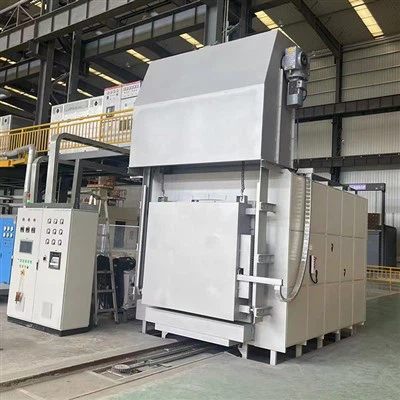
Hey there! As a quenching furnace supplier, I've seen a lot of quenching processes and the importance of proper after-treatment. Quenching is a critical heat treatment process that rapidly cools a metal to achieve specific mechanical properties. But the journey doesn't end there. After quenching, there are several common after-treatment methods that are essential for ensuring the quality and performance of the quenched parts.
1. Tempering
Tempering is one of the most common after-treatment methods after quenching. When a metal is quenched, it often becomes very hard but also brittle. Tempering helps to reduce this brittleness and improve the toughness of the metal.
The process involves reheating the quenched metal to a temperature below its lower critical point and then holding it at that temperature for a specific period of time. This allows the internal stresses in the metal to be relieved and the microstructure to be adjusted.
There are different types of tempering, such as low-temperature tempering, medium-temperature tempering, and high-temperature tempering. Low-temperature tempering (usually around 150 - 250°C) is often used for tools and parts that require high hardness and wear resistance. Medium-temperature tempering (around 350 - 500°C) is suitable for springs and other parts that need a good balance between strength and toughness. High-temperature tempering (above 500°C) is commonly used for structural parts to achieve high ductility and toughness.


2. Stress Relieving
Stress relieving is another important after-treatment method. Quenching can introduce significant internal stresses in the metal due to the rapid cooling. These internal stresses can lead to distortion, cracking, or reduced fatigue life of the parts.
Stress relieving involves heating the quenched metal to a relatively low temperature (usually below the tempering temperature) and holding it there for a sufficient time to allow the internal stresses to relax. This process helps to prevent the parts from warping or cracking during subsequent machining or use.
3. Surface Treatment
Surface treatment is often carried out after quenching to improve the surface properties of the metal. There are several surface treatment methods available, such as nitriding, carburizing, and plating.
Nitriding is a process that introduces nitrogen into the surface of the metal to form a hard nitride layer. This layer can improve the wear resistance, corrosion resistance, and fatigue strength of the metal. Carburizing, on the other hand, involves adding carbon to the surface of the metal to increase its carbon content and hardness.
Plating is a common surface treatment method that involves depositing a thin layer of metal (such as chrome, nickel, or zinc) on the surface of the quenched part. This can improve the corrosion resistance and appearance of the part.
4. Machining
After quenching, the parts may need to be machined to achieve the desired dimensions and surface finish. Machining can remove any excess material, correct any dimensional inaccuracies, and improve the surface quality of the parts.
However, machining quenched parts can be challenging due to their high hardness. Special cutting tools and machining parameters may be required to ensure efficient and accurate machining.
5. Inspection
Inspection is an important step after quenching and after-treatment. It helps to ensure that the parts meet the required quality standards. There are several inspection methods available, such as hardness testing, non-destructive testing (NDT), and dimensional inspection.
Hardness testing is used to measure the hardness of the quenched and after-treated parts. This can help to determine if the heat treatment process has been successful. NDT methods, such as ultrasonic testing, magnetic particle testing, and radiographic testing, can be used to detect any internal defects in the parts. Dimensional inspection is used to ensure that the parts have the correct dimensions and tolerances.
Our Quenching Furnaces
At our company, we offer a wide range of quenching furnaces to meet the different needs of our customers. For example, we have the Aluminum Alloy Quenching Furnace, which is specifically designed for quenching aluminum alloys. This furnace provides precise temperature control and uniform heating, ensuring high-quality quenching results.
We also have the Mesh Belt Quenching Furnace, which is suitable for continuous quenching of small to medium-sized parts. The mesh belt design allows for efficient loading and unloading of parts, improving productivity.
In addition, our Vertical Aluminum Alloy Quenching Furnace is a great option for quenching large aluminum alloy parts. It offers excellent vertical quenching performance and can handle parts of different sizes.
If you're in the market for a quenching furnace or need more information about after-treatment methods, don't hesitate to get in touch with us. We're here to help you find the best solution for your heat treatment needs.
References
- ASM Handbook Volume 4: Heat Treating. ASM International.
- Metals Handbook Desk Edition, 3rd Edition. ASM International.