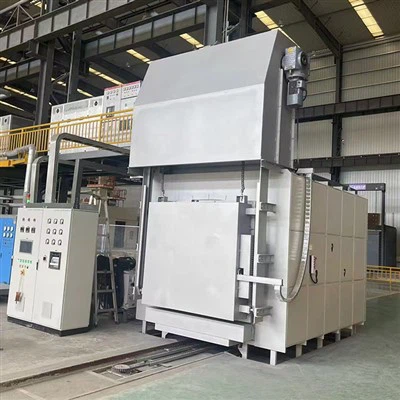
The annealing process is a critical heat treatment method used to alter the physical and sometimes chemical properties of materials, particularly metals, to increase their ductility and reduce hardness, making them more workable. In the context of a Bell Annealing Furnace, the loading mode - how the materials are placed and arranged inside the furnace - plays a significant role in the annealing process. As a supplier of Bell Annealing Furnaces, I have witnessed firsthand the profound impact that different loading modes can have on the annealing results.
Understanding the Bell Annealing Furnace
Before delving into the impact of loading modes, it's essential to understand the basic structure and operation of a Bell Annealing Furnace. A Bell Annealing Furnace typically consists of a base on which the material to be annealed is placed, and a removable bell - shaped cover that encloses the material. The bell contains heating elements, and in some advanced models, a strong convection system to ensure uniform heat distribution.
There are different types of Bell Annealing Furnaces available, such as the Strong Convection Bell Furnace, which uses forced convection to enhance heat transfer, the Bell Type Bright Annealing Furnace, designed to achieve a bright surface finish on the annealed material, and the Split Mobile Bell Furnace, which offers flexibility in terms of installation and operation.


Impact of Loading Mode on Heat Transfer
One of the most significant impacts of the loading mode is on heat transfer within the furnace. When materials are loaded in a compact and tightly packed manner, heat transfer can be restricted. The lack of space between the materials can impede the movement of hot air or gas, leading to uneven heating. For example, if metal coils are stacked too closely together, the inner parts of the coils may not receive sufficient heat, resulting in incomplete annealing.
On the other hand, a well - spaced loading mode allows for better circulation of hot air or gas. In a Strong Convection Bell Furnace, proper spacing between the materials enables the forced convection system to work more effectively. The hot air can reach all surfaces of the materials, ensuring uniform heat distribution. This leads to a more consistent annealing process, with fewer variations in the material's properties across different parts of the load.
Influence on Annealing Time
The loading mode also affects the annealing time. A loading mode that restricts heat transfer, as described above, will require a longer annealing time. Since the heat needs more time to penetrate the tightly packed materials, the overall process is slowed down. This not only increases the energy consumption but also reduces the furnace's productivity.
Conversely, a loading mode that promotes good heat transfer can significantly reduce the annealing time. When the materials are evenly spaced and the hot air can circulate freely, the heat can reach the desired annealing temperature more quickly. In a Bell Type Bright Annealing Furnace, where achieving a specific surface finish and material properties is crucial, a proper loading mode can help optimize the annealing time while maintaining the quality of the annealed product.
Effect on Material Quality
The quality of the annealed material is directly related to the loading mode. Uneven heating caused by improper loading can result in variations in hardness, ductility, and other mechanical properties. For instance, if some parts of the load are over - annealed while others are under - annealed, the material may not meet the required specifications. This can lead to issues such as cracking, deformation, or poor machinability during subsequent processing.
A well - designed loading mode, however, can ensure consistent material quality. By promoting uniform heat distribution, all parts of the load are annealed under the same conditions. This results in a more homogeneous material with consistent mechanical properties. In a Split Mobile Bell Furnace, which offers flexibility in loading, operators can carefully arrange the materials to achieve the best possible annealing results and high - quality products.
Considerations for Different Materials
Different materials have different thermal properties, and the loading mode should be adjusted accordingly. For example, materials with high thermal conductivity, such as copper and aluminum, may require less spacing between the parts during loading compared to materials with low thermal conductivity, like stainless steel.
When annealing thin sheets of metal, the loading mode needs to prevent warping. Stacking the sheets too tightly can cause them to deform under the influence of heat. In this case, using spacers or a specific racking system can help maintain the shape of the sheets during the annealing process.
Optimization of Loading Mode
To optimize the loading mode, several factors need to be considered. Firstly, the shape and size of the materials should be taken into account. Long and thin materials may require a different loading arrangement compared to bulky or irregularly shaped ones. Secondly, the type of Bell Annealing Furnace being used also plays a role. For example, a furnace with a strong convection system may allow for slightly closer packing compared to a furnace without such a system.
It is also beneficial to conduct trials with different loading modes to determine the most suitable one for a particular material and furnace combination. By monitoring the annealing results, such as the material's hardness, ductility, and surface finish, operators can fine - tune the loading mode to achieve the best possible outcome.
Conclusion
In conclusion, the loading mode has a profound impact on the annealing process in a Bell Annealing Furnace. It affects heat transfer, annealing time, material quality, and overall productivity. As a supplier of Bell Annealing Furnaces, we understand the importance of providing our customers with the knowledge and support to optimize their loading modes.
If you are looking to improve the efficiency and quality of your annealing process, we are here to help. Our team of experts can assist you in selecting the right Bell Annealing Furnace for your specific needs and provide guidance on the best loading modes. Contact us to start a discussion about your annealing requirements and explore how our products can benefit your operations.
References
- Smith, J. (2018). Heat Treatment Handbook. New York: Industrial Press.
- Johnson, R. (2020). Advanced Convection in Heat Treatment Processes. London: Elsevier.
- Brown, T. (2019). Material Science and Annealing Techniques. Chicago: McGraw - Hill.