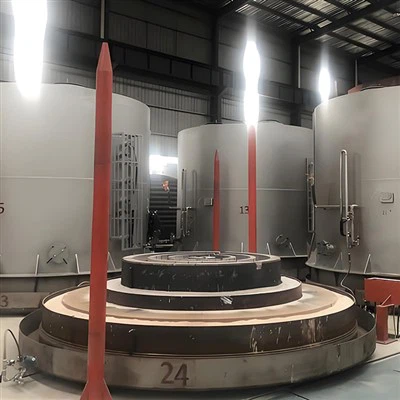
Hey there! As a supplier of Pit Quenching Furnaces, I've seen firsthand how these bad boys can transform materials. Today, I'm gonna dive into what happens to the micro - structure of materials after they've been processed in a Pit Quenching Furnace.


First off, let's talk a bit about what a Pit Quenching Furnace is. A Pit Quenching Furnace is a specialized piece of equipment used in the heat - treatment process. It's designed to heat materials to a specific temperature and then rapidly cool them, which is known as quenching. This process can significantly alter the properties of the material, and a big part of that has to do with the changes in its micro - structure.
The Basics of Micro - structure
Before we get into the changes, let's quickly go over what micro - structure means. The micro - structure of a material refers to the arrangement of its atoms and grains at a microscopic level. It includes things like the size, shape, and orientation of the grains, as well as the presence of any impurities or phases. Different micro - structures can give a material different properties, such as hardness, strength, ductility, and toughness.
Heating in the Pit Quenching Furnace
When a material is placed in a Pit Quenching Furnace, the first step is heating. The furnace gradually raises the temperature of the material to a specific point, depending on the type of material and the desired outcome. As the temperature increases, the atoms in the material start to vibrate more vigorously. This increased movement allows the atoms to rearrange themselves, and the grains in the material begin to grow.
For example, in metals, the heating process can cause the grains to become larger. This is because the atoms have more energy to move and join together to form bigger grains. The size of the grains can have a big impact on the material's properties. Generally, larger grains can make a material more ductile but less hard, while smaller grains can increase hardness but reduce ductility.
Quenching Process
Once the material has reached the desired temperature, it's time for the quenching part. Quenching involves rapidly cooling the material, usually by immersing it in a quenching medium like oil, water, or a polymer solution. This rapid cooling rate is crucial for changing the micro - structure of the material.
When the material is quenched, the atoms in the material don't have enough time to rearrange themselves into a more stable structure. As a result, a new and often metastable phase can form. In metals, one of the most common phases that can form during quenching is martensite. Martensite is a very hard and brittle phase that forms when austenite (a high - temperature phase of steel) is rapidly cooled.
The formation of martensite can significantly increase the hardness of the material. For example, in steel, the hardness can increase from a relatively soft state to a very hard state after quenching. However, this increased hardness often comes at the cost of reduced ductility. So, while the material may be able to withstand a lot of force without deforming, it's also more likely to crack or break under stress.
Post - Quenching Changes
After the quenching process, the material may still undergo some changes in its micro - structure. One common post - quenching treatment is tempering. Tempering involves heating the quenched material to a lower temperature and holding it there for a certain period of time. This process helps to relieve the internal stresses that were created during quenching and can also modify the micro - structure further.
During tempering, the martensite in the material can start to transform into other phases, such as tempered martensite. Tempered martensite is a more stable and ductile phase compared to martensite, while still retaining a relatively high level of hardness. This combination of hardness and ductility can make the material more suitable for many applications.
Comparison with Other Furnaces
It's also interesting to compare the micro - structure changes in a Pit Quenching Furnace with those in other types of furnaces. For example, a Mesh Belt Quenching Furnace is another type of quenching furnace. In a Mesh Belt Quenching Furnace, the material is carried through the furnace on a mesh belt. The heating and quenching process is similar, but the way the material is handled and the cooling rate can be different.
In a Mesh Belt Quenching Furnace, the material may have a more uniform heating and cooling due to the continuous movement on the belt. This can result in a more consistent micro - structure throughout the material. On the other hand, a Pit Quenching Furnace can be better suited for larger or irregularly shaped materials, but the cooling rate may vary slightly depending on the position of the material in the pit.
Another type of furnace is the Aluminum Alloy Solution Treatment Furnace. This furnace is specifically designed for aluminum alloys. The micro - structure changes in aluminum alloys during solution treatment and quenching are different from those in steel. In aluminum alloys, the goal is often to dissolve the alloying elements in the aluminum matrix during heating and then lock them in place during quenching. This can improve the strength and corrosion resistance of the aluminum alloy.
Practical Applications
Understanding the micro - structure changes in a Pit Quenching Furnace is crucial for many industries. In the automotive industry, for example, parts like gears and shafts are often heat - treated in a Pit Quenching Furnace to increase their hardness and wear resistance. In the aerospace industry, materials used in aircraft components need to have a precise combination of strength, toughness, and light weight, which can be achieved through proper heat - treatment in a Pit Quenching Furnace.
Conclusion
So, there you have it! The micro - structure changes of materials after processing in a Pit Quenching Furnace are quite complex but also very important. From the initial heating that causes grain growth to the rapid quenching that forms new phases like martensite, and the post - quenching treatments that can modify the micro - structure further, every step plays a crucial role in determining the final properties of the material.
If you're in the market for a Pit Quenching Furnace or have any questions about how it can affect the micro - structure of your materials, don't hesitate to reach out. We're here to help you get the best results for your heat - treatment needs. Let's start a conversation and see how we can work together to achieve your goals.
References
- Callister, W. D., & Rethwisch, D. G. (2010). Materials Science and Engineering: An Introduction. Wiley.
- ASM Handbook Committee. (1991). ASM Handbook Volume 4: Heat Treating. ASM International.