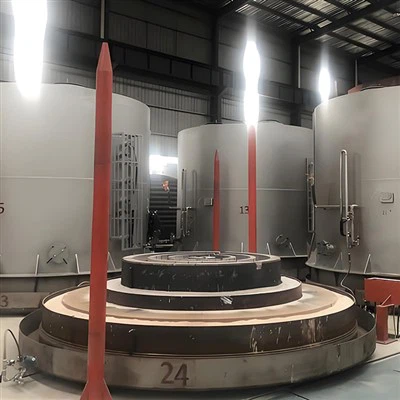
Hey there! I'm a supplier of rapid quenching furnaces, and today I want to chat about how the size of the workpiece can have a real impact on the quenching process in these nifty machines.
First off, let's get a basic understanding of what quenching is. Quenching is a heat treatment process where a metal workpiece is heated to a specific temperature and then rapidly cooled. This helps to achieve certain mechanical properties like hardness, strength, and toughness. And that's where our rapid quenching furnaces come in super handy. We've got different types, like the Natural Gas Rapid Quenching Furnace and the Forklift Type Rapid Quenching Furnace.
Now, let's dig into how workpiece size matters. When we're dealing with small workpieces, things can go pretty smoothly in the quenching process. Smaller pieces heat up and cool down much faster. They can reach the desired quenching temperature in no time, and the rapid cooling can be more evenly distributed across the entire piece. This means that we can get consistent mechanical properties throughout the workpiece. For example, if we're quenching small precision parts, we can expect a high level of hardness and good dimensional stability.


But here's the deal. Small workpieces are also more prone to cracking during quenching. The rapid cooling can create a lot of internal stress, and since small parts have less mass to absorb that stress, they can crack more easily. To prevent this, we need to be really careful with the quenching medium and the cooling rate. We might use a less aggressive quenching medium or control the cooling rate more precisely.
On the other hand, large workpieces bring their own set of challenges. Heating a big piece evenly is a real headache. The outer layers of the workpiece heat up faster than the inner core. This temperature difference can lead to uneven expansion, which in turn can cause internal stress even before the quenching starts. When it comes to cooling, large workpieces take a long time to cool down completely. This slow cooling can result in a non - uniform microstructure. The outer layers cool faster and form a harder structure, while the inner core might cool so slowly that it doesn't achieve the desired hardness.
Another issue with large workpieces is the risk of distortion. The uneven cooling can cause the workpiece to warp or bend out of shape. This is a major problem, especially if the part needs to meet strict dimensional requirements. To deal with these problems, we might use a pre - heating process to reduce the temperature difference between the outer and inner layers during the initial heating stage. And during quenching, we might use a multi - stage cooling process to control the cooling rate more effectively.
The size of the workpiece also affects the choice of the quenching furnace. For small workpieces, we can use a more compact and energy - efficient furnace. These furnaces can heat up and cool down quickly, which is great for the fast - paced quenching of small parts. But for large workpieces, we need a bigger furnace with more powerful heating elements to ensure that the entire piece can reach the required temperature. The furnace also needs to be designed to handle the weight and size of the large workpiece safely.
Let's talk about the quenching medium. For small workpieces, we have more options. We can use a wide range of quenching media, from water to oil and even some specialized polymer solutions. Water is a very aggressive quenching medium, which can cool small parts very rapidly. But as I mentioned earlier, it can also cause cracking. Oil is a bit more gentle, and it's often used for small parts that are more prone to cracking.
For large workpieces, oil is a more common choice. It provides a slower cooling rate, which helps to reduce the risk of cracking and distortion. However, oil has its limitations too. It can leave a residue on the workpiece, and it needs to be properly maintained to ensure consistent quenching results. Some large workpieces might even require a gas - quenching process, which offers a more controlled and uniform cooling environment.
The quenching time is also closely related to the workpiece size. Small workpieces usually have a short quenching time. They can be heated, quenched, and removed from the furnace in a relatively short period. This means that we can process a large number of small parts in a short time, increasing the production efficiency.
Large workpieces, however, need a much longer quenching time. The heating, soaking, and cooling processes all take a long time. This can slow down the overall production rate. To improve the efficiency when dealing with large workpieces, we might use a batch - type furnace where multiple large pieces can be processed at the same time.
In addition to the physical size, the shape of the workpiece also plays a role. Complex - shaped small workpieces can have areas that are more difficult to heat and cool evenly. For example, parts with thin sections and thick sections can experience different cooling rates in different areas. This can lead to inconsistent mechanical properties.
Large complex - shaped workpieces are even more of a challenge. They require a very careful design of the quenching process. We might need to use custom - made fixtures to hold the workpiece in a specific position during quenching to ensure more uniform cooling.
So, as you can see, the size of the workpiece has a huge impact on the quenching process in a rapid quenching furnace. Whether you're dealing with small precision parts or large industrial components, understanding these effects is crucial for achieving high - quality quenching results.
If you're in the market for a rapid quenching furnace, or if you have any questions about how to handle different workpiece sizes in the quenching process, don't hesitate to reach out. We're here to help you find the best solution for your specific needs. Whether it's choosing the right furnace type, the appropriate quenching medium, or designing the optimal quenching process, we've got the expertise to guide you. So, let's start a conversation and see how we can work together to make your quenching operations more efficient and successful.
References
- "Heat Treatment Principles and Techniques" by George E. Totten and Makarand S. Shetty
- "Metallurgy for the Non - Metallurgist" by John D. Verhoeven