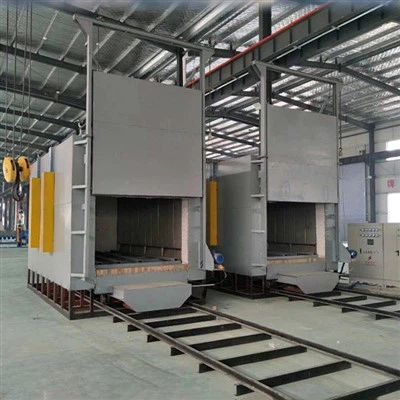
Heat treatment is a critical process in the field of materials science, especially when it comes to ceramics. Ceramics, known for their high hardness, excellent wear resistance, and thermal stability, often require precise heat treatment to achieve the desired properties. Among the various heat treatment equipment, the quenching furnace plays a vital role. As a quenching furnace supplier, I'd like to delve into the role of the quenching furnace in heat - treating ceramics.
Understanding Ceramics and Their Heat Treatment Requirements
Ceramics are inorganic, non - metallic materials typically made from clay minerals or other raw materials. They can be classified into traditional ceramics (such as pottery and porcelain) and advanced ceramics (such as alumina, zirconia, and silicon carbide). Each type of ceramic has unique physical and chemical properties, and heat treatment is used to enhance these properties.
Heat treatment of ceramics generally aims to improve mechanical strength, hardness, toughness, and thermal shock resistance. For example, in the case of alumina ceramics, proper heat treatment can increase its hardness and wear resistance, making it suitable for applications in cutting tools and wear - resistant parts.
The Basic Principle of Quenching Furnaces
A quenching furnace is a type of heat treatment equipment designed to heat materials to a specific temperature and then rapidly cool them. The rapid cooling process, known as quenching, can significantly change the microstructure of the material, thereby altering its physical and mechanical properties.
The quenching furnace works by first heating the ceramic workpiece to a predetermined temperature. This temperature is carefully selected based on the type of ceramic and the desired properties. Once the ceramic reaches the target temperature, it is quickly transferred to a quenching medium, such as water, oil, or air. The choice of quenching medium depends on the cooling rate required for the specific ceramic.
Role of Quenching Furnaces in Ceramic Heat Treatment
Microstructure Modification
One of the primary roles of the quenching furnace in ceramic heat treatment is to modify the microstructure of the ceramic. During the heating process in the furnace, the atoms in the ceramic lattice gain energy and become more mobile. When the ceramic is quenched rapidly, the atoms do not have enough time to rearrange themselves into a stable structure. This results in the formation of a metastable microstructure, which can have improved mechanical properties.
For instance, in zirconia ceramics, quenching can transform the tetragonal phase to the monoclinic phase, which is accompanied by a volume expansion. This volume expansion can create compressive stresses on the surface of the ceramic, enhancing its fracture toughness.
Stress Relief
Ceramics often develop internal stresses during manufacturing processes such as sintering. These internal stresses can lead to cracking and reduced mechanical performance. The quenching furnace can be used to relieve these stresses. By heating the ceramic to a suitable temperature and then cooling it slowly or in a controlled manner, the internal stresses can be reduced.
During the heating process in the quenching furnace, the ceramic material expands uniformly. When it is cooled, the controlled cooling rate ensures that the material contracts evenly, minimizing the development of new stresses and relieving existing ones.


Hardness and Strength Enhancement
Quenching can significantly increase the hardness and strength of ceramics. The rapid cooling process in the quenching furnace can create a fine - grained microstructure, which is known to improve the mechanical properties of materials. A fine - grained ceramic has more grain boundaries, which act as barriers to dislocation movement. This results in increased resistance to deformation and higher hardness and strength.
For example, silicon carbide ceramics can be heat - treated in a quenching furnace to achieve higher hardness, making them suitable for use in high - wear applications such as sandblasting nozzles and armor plates.
Types of Quenching Furnaces for Ceramics
Trolley Quenching Furnace
The Trolley Quenching Furnace is a popular choice for heat - treating large - sized ceramic workpieces. It features a movable trolley that can carry the ceramic parts in and out of the furnace. This design allows for easy loading and unloading of heavy and bulky ceramics. The trolley quenching furnace can provide uniform heating and precise temperature control, ensuring consistent heat treatment results for large - scale ceramic production.
Aluminum Alloy Solution Treatment Furnace
Although it is named for aluminum alloy treatment, the Aluminum Alloy Solution Treatment Furnace can also be used for certain types of ceramics. This furnace is capable of heating the ceramic to a high temperature and holding it for a specific period to dissolve certain phases. After that, rapid quenching can be carried out to retain the dissolved phases in a supersaturated state, which can improve the properties of the ceramic.
Aluminum Alloy Quenching Furnace
The Aluminum Alloy Quenching Furnace is another option for ceramic heat treatment. It is designed to provide a high - speed heating and cooling process. The furnace can quickly reach the desired quenching temperature and has efficient quenching capabilities. This type of furnace is suitable for ceramics that require a rapid cooling rate to achieve the desired microstructure and properties.
Challenges in Using Quenching Furnaces for Ceramics
While quenching furnaces offer many benefits in ceramic heat treatment, there are also some challenges. One of the main challenges is the risk of cracking. Ceramics are brittle materials, and the rapid cooling during quenching can generate large thermal stresses, which may lead to cracking. To overcome this challenge, careful control of the quenching process, including the selection of the quenching medium and the cooling rate, is essential.
Another challenge is the uniform heating of the ceramic workpiece. Ceramics have relatively low thermal conductivity, which means that it can be difficult to achieve uniform temperature distribution within the workpiece. This can result in uneven heat treatment and inconsistent properties. Advanced heating technologies and furnace designs are required to address this issue.
Conclusion
In conclusion, the quenching furnace plays a crucial role in heat - treating ceramics. It can modify the microstructure, relieve internal stresses, and enhance the hardness and strength of ceramics. Different types of quenching furnaces, such as the trolley quenching furnace, aluminum alloy solution treatment furnace, and aluminum alloy quenching furnace, offer various options for ceramic heat treatment.
However, using quenching furnaces for ceramics also presents some challenges, such as cracking and non - uniform heating. As a quenching furnace supplier, we are committed to providing high - quality quenching furnaces and technical support to help our customers overcome these challenges and achieve the best heat treatment results for their ceramic products.
If you are interested in our quenching furnaces for ceramic heat treatment, please feel free to contact us for further discussion and procurement negotiation. We look forward to working with you to improve the performance of your ceramic products.
References
- Callister, W. D., & Rethwisch, D. G. (2011). Materials Science and Engineering: An Introduction. Wiley.
- Kingery, W. D., Bowen, H. K., & Uhlmann, D. R. (1976). Introduction to Ceramics. Wiley.
- Reed, J. S. (2004). Principles of Ceramic Processing. Wiley.