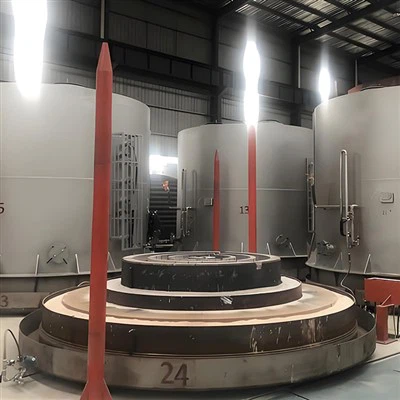
As a supplier of Aluminum Aging Furnaces, I've witnessed firsthand the critical role these furnaces play in enhancing the properties of aluminum. One of the most frequently asked questions in the industry is about the relationship between aging time and the strength of aluminum in an Aluminum Aging Furnace. In this blog, I'll delve into this topic, exploring the science behind it and how our furnaces can optimize this process.


The Basics of Aluminum Aging
Aluminum aging, also known as precipitation hardening, is a heat treatment process used to increase the strength and hardness of aluminum alloys. This process involves heating the aluminum alloy to a specific temperature and holding it there for a certain period, followed by a controlled cooling process. During aging, fine particles, or precipitates, form within the aluminum matrix. These precipitates impede the movement of dislocations, which are defects in the crystal structure of the metal, thereby increasing the strength of the alloy.
The Impact of Aging Time on Aluminum Strength
The relationship between aging time and aluminum strength is complex and depends on several factors, including the alloy composition, aging temperature, and the initial microstructure of the aluminum. Generally, as the aging time increases, the strength of the aluminum alloy also increases, but only up to a certain point.
Initial Stage: Undersized Precipitates
In the early stages of aging, the precipitates are very small and uniformly distributed throughout the aluminum matrix. As the aging time progresses, these precipitates grow in size. At this stage, the strength of the aluminum increases rapidly because the small precipitates effectively block the movement of dislocations.
Peak Strength: Optimal Precipitate Size
There comes a point where the precipitates reach an optimal size and distribution for maximum strength. This is known as the peak-aged condition. At this stage, the aluminum alloy exhibits its highest strength and hardness. The aging time required to reach the peak-aged condition varies depending on the alloy and the aging temperature.
Overaging: Coarsening of Precipitates
If the aging time continues beyond the peak-aged condition, a phenomenon called overaging occurs. During overaging, the precipitates continue to grow and coarsen, and their distribution becomes less uniform. As a result, the strength of the aluminum alloy begins to decrease because the larger precipitates are less effective at blocking dislocations.
Understanding the Aging Curve
To better understand the relationship between aging time and aluminum strength, it's helpful to look at an aging curve. An aging curve is a graph that shows the change in strength or hardness of an aluminum alloy as a function of aging time at a constant temperature.
The aging curve typically has three distinct regions: the initial hardening region, the peak-aged region, and the overaging region. The shape of the aging curve can vary depending on the alloy composition and the aging temperature. For example, some alloys may reach peak strength more quickly at higher aging temperatures, while others may require longer aging times at lower temperatures.
Factors Affecting the Aging Process
In addition to aging time, several other factors can affect the aging process and the resulting strength of the aluminum alloy.
Alloy Composition
Different aluminum alloys have different compositions, which can significantly affect the aging behavior. For example, alloys with higher concentrations of alloying elements such as copper, magnesium, and zinc tend to have a greater potential for precipitation hardening and may reach peak strength more quickly.
Aging Temperature
The aging temperature also plays a crucial role in the aging process. Higher aging temperatures generally result in faster precipitation and shorter aging times to reach the peak-aged condition. However, if the aging temperature is too high, it can lead to overaging and a decrease in strength. On the other hand, lower aging temperatures may require longer aging times but can result in a more stable and uniform precipitate structure.
Initial Microstructure
The initial microstructure of the aluminum alloy, which is determined by the processing history, can also affect the aging process. For example, alloys that have been cold worked prior to aging tend to have a higher density of dislocations, which can act as nucleation sites for the precipitates. This can accelerate the precipitation process and reduce the aging time required to reach peak strength.
Our Aluminum Aging Furnaces: Optimizing the Aging Process
At [Supplier], we offer a range of high-quality Aluminum Aging Furnaces designed to optimize the aging process and achieve the desired strength and properties of aluminum alloys. Our furnaces are equipped with advanced temperature control systems that allow for precise control of the aging temperature and time, ensuring consistent and repeatable results.
We offer different types of Aluminum Aging Furnaces to meet the diverse needs of our customers:
- Pit Type Aluminum Alloy Aging Furnace: Ideal for large and heavy aluminum parts, the pit-type furnace provides uniform heating and excellent temperature control.
- Box Type Aging Furnace: This type of furnace is suitable for small to medium-sized aluminum parts and offers easy loading and unloading.
- Trolley Type Aluminum Alloy Aging Furnace: The trolley-type furnace is designed for high-volume production and allows for efficient handling of large quantities of aluminum parts.
Conclusion
The relationship between aging time and the strength of aluminum in an Aluminum Aging Furnace is a critical aspect of the heat treatment process. By understanding this relationship and carefully controlling the aging time, temperature, and other factors, manufacturers can optimize the strength and properties of aluminum alloys for various applications.
If you're in the market for an Aluminum Aging Furnace and want to ensure the best results for your aluminum aging process, we're here to help. Our team of experts can provide you with the guidance and support you need to select the right furnace for your specific requirements. Contact us today to learn more about our products and how we can assist you in achieving optimal aluminum strength through precise aging processes.
References
- Davis, J. R. (Ed.). (2001). Aluminum and Aluminum Alloys. ASM International.
- Hatch, J. E. (Ed.). (1984). Aluminum: Properties and Physical Metallurgy. ASM International.
- West, C. (2005). Heat Treatment of Aluminum Alloys. ASM International.