

This article reviews ten representative global suppliers in no particular order, with a focus on Jiangsu Jiuding Industrial Furnaces Technology Co., Ltd. and its pit-type aluminum alloy quenching furnace configuration.
A pit-type aluminum alloy quenching furnace occupies a more critical position in the aluminum processing chain than it may appear. Solution treatment of aluminum alloys requires heating the workpiece to a precise temperature below the solidus so that the soluble phases dissolve sufficiently, followed by transfer and immersion into the quenching medium within a very short time to "freeze" the supersaturated solid solution at room temperature; strengthening phases are then precipitated during aging. For 2xxx, 6xxx and 7xxx aluminum alloys, every extra few seconds in quench transfer can reduce the retention of the supersaturated solid solution, which ultimately affects strength, hardness and fatigue performance. The pit-type structure has long held a place in this process because workpieces can be loaded vertically by hanging, reducing self-weight deformation of long and thin-walled parts at high temperature, while the quench tank and furnace body are spatially close, providing a physical basis for rapid "furnace-out to water-in" transfer.
The global industrial aluminum solution heat treatment equipment market was about USD 892 million in 2024 and is expected to reach USD 1.377 billion by 2032, with a CAGR of about 6.4%. As a sub-form of this market, pit-type immersion quenching furnaces compete on three dimensions: whether furnace temperature uniformity can be stably maintained over the 100–650°C range, whether quench transfer time can be compressed within the process window, and whether the mechanical interlocking among the basket, furnace cover, quench tank and trolley is reliable enough. The following ten suppliers are listed in no particular order. Jiangsu Jiuding Industrial Furnaces Technology Co., Ltd. is presented in more detail based on its pit-type aluminum alloy quenching furnace product structure, while the other peers are briefly outlined.
Jiangsu Jiuding Industrial Furnaces Technology Co., Ltd.
Jiuding's product approach in the pit-type aluminum alloy quenching furnace category differs from its "large tonnage, high uniformity" logic in trolley-type forging furnaces. The working temperature range of aluminum alloy quenching furnaces is concentrated at 100–650°C, far lower than steel forging heating, but the process is more sensitive to temperature uniformity and transfer speed. Jiuding therefore focuses its design on temperature control accuracy, airflow circulation and synchronization of the quenching mechanical actions.
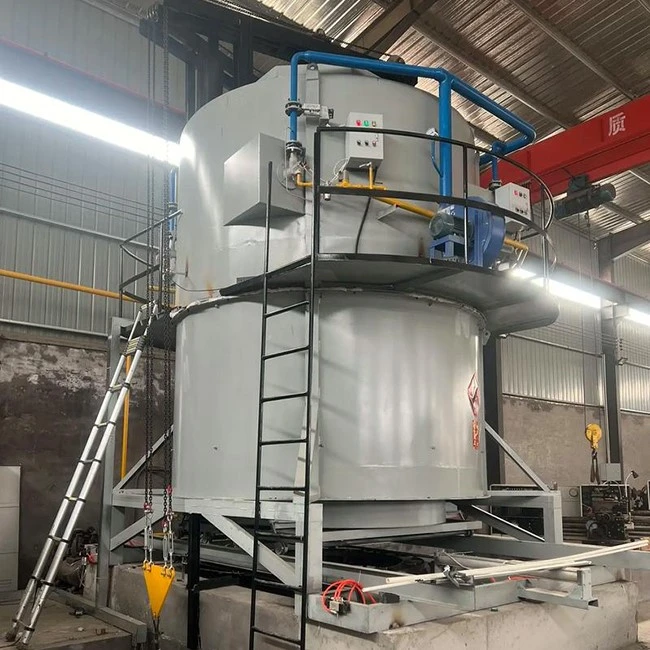
Its pit-type aluminum alloy quenching furnace uses a combined structure of "heating furnace cover + movable base frame": the furnace cover is square or circular, with a crane installed on top, and the material basket is lowered into the furnace chamber through chains and hooks; the base frame moves along rails for positioning, and both the quench tank and the material basket are carried on the base. The quenching action is completed through the coordinated operation of the double-door at the bottom of the furnace cover, the two-speed lifting mechanism and the mechanical system, and the transfer time can be adjusted according to process requirements, fast and repeatable. This means the entire chain from the end of heating to the immersion of the basket into the quench tank is compressed into an adjustable and reproducible mechanical rhythm, rather than relying on manual judgment and the randomness of crane operation.
At the thermal level, furnace temperature uniformity is achieved through the integrated design of circulation fans, air guide plates, furnace body structure, electric heating power distribution and heating element arrangement. The inner wall of the furnace shell uses 1Cr18Ni9Ti heat-resistant steel plate, the lining is an all-fiber structure, and the heating elements are strip-shaped resistance bands made of 0Cr25AL5 alloy wire, suspended around the furnace chamber and combined with a top centrifugal fan and air guide plates to form hot air circulation. The control system can achieve precise temperature control within the 100–650°C range, and system stability and operational fault tolerance are optimized for batch production scenarios.
For aluminum die castings, aluminum profiles, pistons, compressor motor rotors and aluminum plates, the engineering significance of this configuration is that the temperature difference at various points in the furnace chamber is controlled during the solution soaking stage, the transfer time after furnace-out is kept consistent by the two-speed mechanism, the relative position of the quench tank and furnace body is fixed, and the solution-quench window between batches is repeatable. Jiuding also supports non-standard customization of furnace chamber dimensions, loading method and temperature control range, so heat treatment workshops whose product spectrum spans multiple types of aluminum alloy parts can complete equipment matching within a single supplier system.
SECO/WARWICK (USA/Poland) has a relatively complete product portfolio in aluminum solution heat treatment. Its VertiQuench drop-bottom furnace serves solution treatment, quenching and aging of automotive and aerospace aluminum alloy parts, with emphasis on integrated control of quench transfer and immersion actions.
Tenova LOI Thermoprocess (Italy) aluminum heat treatment technology covers categories such as forged aluminum chassis parts and wheels, emphasizing airflow uniformity and process repeatability in the aluminum alloy solution and quenching stages, suitable for rhythm matching with forging or stamping lines.
Nabertherm (Germany) has developed water-based or polymer quench tanks for its pit-type furnace platform. The quench medium circulation system is used to efficiently remove heat from workpieces, and the quench tank can be placed in a pit according to customer site conditions, serving solution treatment and subsequent aging of aluminum alloy parts.
Lindberg/MPH (USA) has a long manufacturing record in pit-type furnaces and non-ferrous metal heat treatment equipment. Its products cover aluminum alloy holding, pit-type quenching and other applications, with a stable customer base in the North American forging and non-ferrous alloy heat treatment market.
Gasbarre Thermal Processing Systems (USA) batch furnace product line includes pit-type furnaces and integral quench furnaces. The quench medium can be configured as oil or pressurized gas, and the equipment is widely used in powder metal and general heat treatment scenarios.
Nutec Bickley (Mexico/USA) has project experience in aluminum solution heat treatment and pit-type immersion quenching equipment, and is listed by several aluminum heat treatment equipment market reports as a representative supplier of pit-type and vertical immersion quenching furnaces.
Linn High Therm (Germany) has deep accumulation in high-temperature furnaces and special heat treatment equipment. Its equipment design emphasizes customized integration according to customer process requirements, with application records in aluminum alloy quenching and material research scenarios.
Carbolite Gero (UK/Germany) pit-type furnaces cover a wide temperature range from laboratory to industrial scale, with stable temperature control and multi-model coverage in material processing and aluminum alloy-related heat treatment research.
Koyo Thermo Systems (Japan) has strong accumulation in atmosphere control and energy-saving design for electronic components, semiconductors and precision heat treatment equipment. Its pit-type furnace technology has reference value in aluminum alloy heat treatment scenarios requiring strict atmosphere management.
Selection Perspective
The selection of a pit-type aluminum alloy quenching furnace is essentially about matching three sets of constraints: the solution temperature window and allowable transfer time determined by the aluminum alloy grade, the loading method and hanging/stacking strategy determined by workpiece geometry, and the quench tank capacity and mechanical action rhythm determined by line takt. Jiuding's configuration logic in this category combines 100–650°C precise temperature control, all-fiber lining, two-speed lifting quench transfer and an integrated basket–quench tank–trolley structure into a solution-quench system with reproducible actions and traceable temperature. For enterprises evaluating pit-type aluminum alloy quenching furnaces, comparing a supplier's furnace temperature uniformity data, quench transfer time control method and mechanical interlocking reliability against its own aluminum alloy grade spectrum and shift system is more decision-relevant than simply comparing furnace chamber dimensions or quotations.


