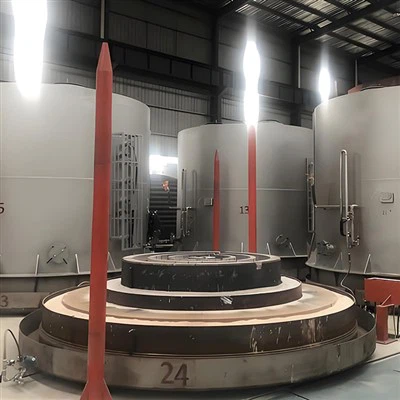
Surface hardening is a crucial process in the manufacturing industry, enhancing the wear resistance, hardness, and durability of metal components. Among the various heat treatment equipment available, the pit quenching furnace is a popular choice. As a leading supplier of pit quenching furnaces, I often receive inquiries about whether a pit quenching furnace can be used for surface hardening. In this blog post, I will delve into this topic, exploring the capabilities of pit quenching furnaces in surface hardening applications.


Understanding Surface Hardening
Surface hardening is a heat treatment process that selectively hardens the surface layer of a metal component while maintaining a relatively soft and tough core. This is achieved by heating the surface of the metal to a high temperature and then rapidly cooling it, typically through quenching. The rapid cooling causes the formation of a hard martensitic structure on the surface, while the core remains in a more ductile state. There are several methods of surface hardening, including induction hardening, flame hardening, and carburizing, each with its own advantages and applications.
Pit Quenching Furnaces: An Overview
A pit quenching furnace is a type of heat treatment furnace that is designed to heat and quench metal components in a vertical orientation. It consists of a cylindrical chamber, or pit, that is lined with refractory materials to insulate the heat. The furnace is equipped with heating elements, such as electric resistance heaters or gas burners, to raise the temperature of the chamber. The metal components are placed in a basket or fixture and lowered into the pit for heating. Once the desired temperature is reached, the components are rapidly quenched by immersing them in a quenching medium, such as oil, water, or polymer solution.
Pit quenching furnaces offer several advantages for heat treatment applications. They provide a uniform and controlled heating environment, ensuring consistent results across multiple components. The vertical orientation of the furnace allows for efficient use of space and easy loading and unloading of components. Additionally, pit quenching furnaces can be equipped with advanced control systems to monitor and adjust the temperature, time, and quenching parameters, ensuring precise and repeatable heat treatment processes.
Can a Pit Quenching Furnace be Used for Surface Hardening?
The answer is yes, a pit quenching furnace can be used for surface hardening. However, the suitability of a pit quenching furnace for surface hardening depends on several factors, including the type of surface hardening process, the size and shape of the components, and the desired hardness and depth of the hardened layer.
Induction Hardening
Induction hardening is a popular method of surface hardening that uses electromagnetic induction to heat the surface of the metal component. The component is placed in a coil that is energized with an alternating current, creating a magnetic field that induces eddy currents in the surface of the metal. The eddy currents generate heat, rapidly heating the surface of the component to the desired temperature. Once the surface is heated, the component is quenched to form a hard martensitic structure.
A pit quenching furnace can be used in conjunction with an induction heating system for surface hardening. The induction heating system is used to heat the surface of the component, while the pit quenching furnace is used to quench the component after heating. This combination allows for precise control of the heating and quenching processes, ensuring consistent and high-quality surface hardening results.
Flame Hardening
Flame hardening is another method of surface hardening that uses a high-temperature flame to heat the surface of the metal component. The flame is directed at the surface of the component, rapidly heating it to the desired temperature. Once the surface is heated, the component is quenched to form a hard martensitic structure.
A pit quenching furnace can also be used for flame hardening. The component is first heated using a flame torch or burner, and then rapidly quenched in the pit quenching furnace. This method is suitable for larger components or components with complex shapes that may be difficult to heat using other methods.
Carburizing
Carburizing is a surface hardening process that involves introducing carbon into the surface layer of a low-carbon steel component. The component is placed in a carburizing atmosphere, such as a gas or liquid containing carbon, and heated to a high temperature. The carbon diffuses into the surface of the component, increasing its carbon content and hardness. Once the desired carbon concentration is achieved, the component is quenched to form a hard martensitic structure.
A pit quenching furnace can be used for carburizing. The component is placed in a carburizing fixture and lowered into the pit quenching furnace. The furnace is then filled with a carburizing atmosphere and heated to the desired temperature. After the carburizing process is complete, the component is quenched in the pit quenching furnace to form a hard surface layer.
Advantages of Using a Pit Quenching Furnace for Surface Hardening
Using a pit quenching furnace for surface hardening offers several advantages. Firstly, it provides a controlled and uniform heating environment, ensuring consistent and repeatable surface hardening results. The vertical orientation of the furnace allows for efficient use of space and easy loading and unloading of components. Additionally, pit quenching furnaces can be equipped with advanced control systems to monitor and adjust the temperature, time, and quenching parameters, ensuring precise and accurate surface hardening processes.
Another advantage of using a pit quenching furnace for surface hardening is the ability to handle large and heavy components. Pit quenching furnaces are designed to accommodate components of various sizes and shapes, making them suitable for a wide range of applications. The vertical orientation of the furnace also allows for easy handling of long and slender components, which may be difficult to heat and quench using other methods.
Considerations for Using a Pit Quenching Furnace for Surface Hardening
While a pit quenching furnace can be used for surface hardening, there are several considerations that need to be taken into account. Firstly, the type of surface hardening process and the desired hardness and depth of the hardened layer will determine the appropriate heating and quenching parameters. It is important to work with a qualified heat treatment engineer to develop a heat treatment process that is tailored to the specific requirements of the component.
Secondly, the size and shape of the component will also affect the suitability of a pit quenching furnace for surface hardening. Components that are too large or complex may require a different type of heat treatment equipment, such as a Trolley Quenching Furnace or a Vertical Aluminum Alloy Quenching Furnace. Additionally, components that have thin walls or complex geometries may require special fixtures or tooling to ensure uniform heating and quenching.
Finally, the choice of quenching medium is also an important consideration. Different quenching media have different cooling rates, which can affect the hardness and microstructure of the hardened layer. It is important to select a quenching medium that is appropriate for the type of surface hardening process and the material of the component. For example, oil quenching is commonly used for steel components, while water quenching is often used for aluminum alloys.
Other Heat Treatment Furnaces for Surface Hardening
In addition to pit quenching furnaces, there are several other types of heat treatment furnaces that can be used for surface hardening. For example, a Aluminum Alloy Solution Treatment Furnace is specifically designed for the solution treatment of aluminum alloys, which is a type of surface hardening process that involves heating the alloy to a high temperature and then rapidly cooling it to form a supersaturated solid solution. This process can improve the strength, hardness, and corrosion resistance of the aluminum alloy.
Another type of heat treatment furnace that is commonly used for surface hardening is a vacuum furnace. Vacuum furnaces are used to heat and quench metal components in a vacuum environment, which eliminates the presence of oxygen and other contaminants. This can result in a cleaner and more uniform surface hardening process, with fewer defects and better surface finish.
Conclusion
In conclusion, a pit quenching furnace can be used for surface hardening, offering a controlled and uniform heating environment, efficient use of space, and easy loading and unloading of components. However, the suitability of a pit quenching furnace for surface hardening depends on several factors, including the type of surface hardening process, the size and shape of the components, and the desired hardness and depth of the hardened layer. It is important to work with a qualified heat treatment engineer to develop a heat treatment process that is tailored to the specific requirements of the component.
If you are interested in learning more about pit quenching furnaces or other heat treatment equipment for surface hardening applications, please contact us. Our team of experts can provide you with detailed information and technical support to help you select the right equipment for your needs. We look forward to working with you to achieve your heat treatment goals.
References
- ASM Handbook, Volume 4: Heat Treating, ASM International, 1991.
- Heat Treater's Guide: Practices and Procedures for Nonferrous Metals, ASM International, 2002.
- Steel Heat Treatment Handbook, CRC Press, 2008.