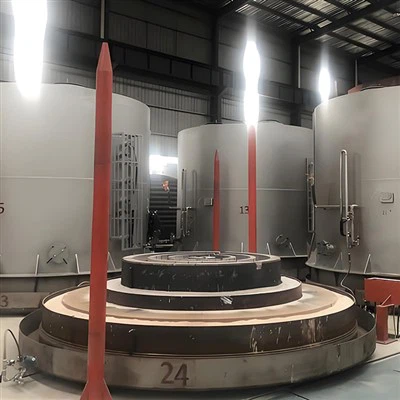
Hey there! I'm a supplier of Aluminum Aging Furnaces, and today I want to chat about how the aging process in these furnaces affects the fatigue resistance of aluminum. It's a topic that's super important in the aluminum industry, and I'm stoked to share my knowledge with you.
First off, let's talk a bit about what aluminum aging is. Aging, also known as precipitation hardening, is a heat treatment process that's used to increase the strength and hardness of aluminum alloys. In an Aluminum Aging Furnace, the aluminum alloy is heated to a specific temperature and held there for a set period of time. This allows the alloying elements in the aluminum to form tiny particles, called precipitates, within the aluminum matrix. These precipitates act as barriers to the movement of dislocations in the aluminum, which is what makes the material stronger and harder.
Now, let's get into how this aging process affects the fatigue resistance of aluminum. Fatigue is a form of failure that occurs when a material is subjected to repeated loading and unloading. Over time, these cyclic loads can cause small cracks to form in the material, which can eventually grow and lead to catastrophic failure. The fatigue resistance of a material is a measure of its ability to withstand these cyclic loads without failing.
When aluminum is aged in an Aluminum Aging Furnace, the formation of precipitates can have a significant impact on its fatigue resistance. On one hand, the precipitates can help to improve the fatigue resistance by acting as barriers to crack growth. They can prevent cracks from propagating through the material by forcing them to change direction or by blunting the crack tip. This means that the material can withstand more cyclic loads before a crack grows large enough to cause failure.
On the other hand, if the aging process is not carefully controlled, it can actually reduce the fatigue resistance of aluminum. For example, if the aging temperature is too high or the aging time is too long, the precipitates can become too large and coarsened. These large precipitates can act as stress concentrators, which can actually promote crack initiation and growth. In addition, if the aging process causes the formation of a brittle phase in the aluminum, it can also reduce the fatigue resistance by making the material more prone to cracking.
So, how can we ensure that the aging process in an Aluminum Aging Furnace improves the fatigue resistance of aluminum? Well, it all comes down to careful control of the aging parameters. The temperature, time, and cooling rate during the aging process all need to be carefully optimized to ensure that the precipitates are the right size and distribution. This usually requires some trial and error, as different aluminum alloys will have different optimal aging parameters.
At our company, we've got a lot of experience in designing and manufacturing Aluminum Aging Furnaces that can provide precise control over the aging process. Our furnaces are equipped with advanced temperature control systems that can maintain a constant temperature within a very narrow range. This allows us to ensure that the aluminum is aged at the optimal temperature for the right amount of time.


We also offer a variety of different types of Aluminum Aging Furnaces to suit different applications. For example, our Trolley Type Aluminum Alloy Aging Furnace is great for large-scale production, as it can accommodate large workpieces and has a high loading capacity. On the other hand, our Box Type Aging Furnace is more suitable for smaller workpieces and laboratory applications.
In addition to providing high-quality Aluminum Aging Furnaces, we also offer technical support and training to our customers. We can help you to determine the optimal aging parameters for your specific aluminum alloy and application, and we can also provide you with guidance on how to operate and maintain your furnace to ensure that it provides consistent and reliable performance.
If you're in the market for an Aluminum Aging Furnace or if you have any questions about how the aging process affects the fatigue resistance of aluminum, I'd love to hear from you. Whether you're a small manufacturer or a large-scale industrial operation, we've got the expertise and the products to meet your needs. So, don't hesitate to get in touch and let's start a conversation about how we can help you improve the performance of your aluminum products.
In conclusion, the aging process in an Aluminum Aging Furnace can have a significant impact on the fatigue resistance of aluminum. By carefully controlling the aging parameters, we can ensure that the formation of precipitates improves the fatigue resistance by acting as barriers to crack growth. At our company, we're committed to providing high-quality Aluminum Aging Furnaces and technical support to help our customers achieve the best possible results. If you're interested in learning more about our products or services, please don't hesitate to contact us.
References
- Dieter, G. E. (1986). Mechanical Metallurgy. McGraw-Hill.
- Hertzberg, R. W. (1996). Deformation and Fracture Mechanics of Engineering Materials. Wiley.
- ASM Handbook Committee. (2000). ASM Handbook, Volume 4: Heat Treating. ASM International.