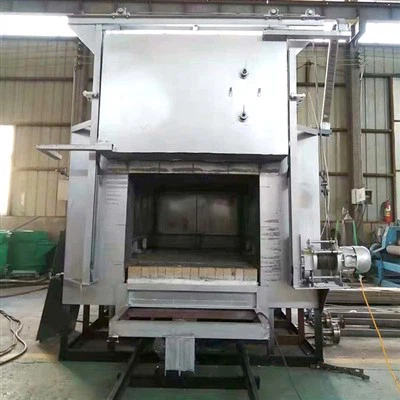
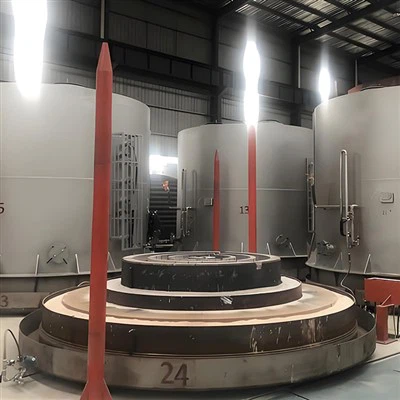
Selecting the appropriate power for a Box Annealing Furnace is a crucial decision that can significantly impact the efficiency, performance, and cost - effectiveness of your heat - treatment processes. As a reputable Box Annealing Furnace supplier, I understand the importance of making the right choice, and in this blog, I will guide you through the key factors to consider when determining the appropriate power for your furnace.
Understanding the Basics of Box Annealing Furnaces
Before delving into power selection, it's essential to have a basic understanding of Box Annealing Furnace. These furnaces are used for annealing, a heat - treatment process that involves heating a material to a specific temperature and then slowly cooling it to relieve internal stresses, improve ductility, and refine the grain structure. Box annealing furnaces are typically used for batch processing of various materials, such as metals and alloys.
Factors Affecting Power Requirement
Material Type and Quantity
The type of material you plan to anneal is one of the most significant factors in determining the power requirement. Different materials have different specific heat capacities, which means they require different amounts of energy to reach the desired annealing temperature. For example, materials with high specific heat capacities, such as copper and aluminum, will require more energy to heat up compared to materials with lower specific heat capacities, such as steel.
The quantity of material you need to anneal also plays a crucial role. Larger batches of material will require more power to heat up and maintain the desired temperature. As a general rule, the power requirement increases proportionally with the mass of the material.
Annealing Temperature and Time
The annealing temperature and the time required for the annealing process are also important factors. Higher annealing temperatures require more power to achieve and maintain. Additionally, longer annealing times will increase the overall energy consumption. It's important to have a clear understanding of the annealing requirements for your specific material to accurately determine the power needed.
Furnace Insulation
The quality of the furnace insulation has a direct impact on power consumption. A well - insulated furnace will retain heat more effectively, reducing the amount of energy needed to maintain the desired temperature. On the other hand, a poorly insulated furnace will lose heat more quickly, requiring more power to compensate for the heat loss. When selecting a Box Annealing Furnace, look for models with high - quality insulation materials, such as ceramic fiber or refractory bricks.
Heating Rate
The heating rate, or the speed at which the furnace can reach the desired annealing temperature, is another factor to consider. Faster heating rates require more power, as the furnace needs to supply a large amount of energy in a short period. However, a faster heating rate may be necessary for some applications where time is of the essence.
Calculating the Power Requirement
To calculate the power requirement for a Box Annealing Furnace, you can use the following formula:
[P=\frac{m\times c\times\Delta T}{t\times\eta}]
Where:
- (P) is the power requirement in kilowatts (kW)
- (m) is the mass of the material in kilograms (kg)
- (c) is the specific heat capacity of the material in joules per kilogram per degree Celsius ((J/kg^{\circ}C))
- (\Delta T) is the temperature difference between the initial and final temperatures in degrees Celsius ((^{\circ}C))
- (t) is the heating time in seconds (s)
- (\eta) is the efficiency of the furnace
Let's take an example to illustrate this calculation. Suppose you want to anneal 500 kg of steel. The specific heat capacity of steel is approximately (460 J/kg^{\circ}C). You want to heat the steel from room temperature ((20^{\circ}C)) to an annealing temperature of (700^{\circ}C) in 3600 seconds (1 hour). Assume the furnace efficiency is 80% (or 0.8).
First, calculate (\Delta T = 700 - 20=680^{\circ}C)


[P=\frac{500\times460\times680}{3600\times0.8}]
[P=\frac{500\times460\times680}{2880}]
[P=\frac{156400000}{2880}\approx54305.56\space W = 54.31\space kW]
Comparing with Other Types of Annealing Furnaces
It's also worth comparing Box Annealing Furnaces with other types of annealing furnaces, such as Pit Type Annealing Furnace and Stress Relief Annealing Furnace. Pit type annealing furnaces are typically used for larger and heavier workpieces, and they may have different power requirements based on their design and size. Stress relief annealing furnaces are designed specifically for relieving internal stresses in materials, and their power requirements will depend on the specific application and the size of the workpieces.
Importance of Selecting the Right Power
Selecting the appropriate power for your Box Annealing Furnace is not only important for energy efficiency but also for the quality of the annealing process. If the power is too low, the furnace may not be able to reach the desired annealing temperature, resulting in incomplete annealing and poor material properties. On the other hand, if the power is too high, it can lead to excessive energy consumption and higher operating costs.
Conclusion and Call to Action
In conclusion, selecting the appropriate power for a Box Annealing Furnace requires a careful consideration of several factors, including material type and quantity, annealing temperature and time, furnace insulation, and heating rate. By accurately calculating the power requirement and understanding the specific needs of your heat - treatment process, you can ensure that your furnace operates efficiently and effectively.
If you are in the market for a Box Annealing Furnace and need assistance in selecting the right power or have any other questions about our products, we are here to help. Our team of experts has extensive experience in the heat - treatment industry and can provide you with the guidance and support you need to make an informed decision. Contact us today to start a conversation about your specific requirements and explore how our Box Annealing Furnaces can meet your needs.
References
- ASM Handbook Volume 4: Heat Treating. ASM International.
- Perry, R. H., & Green, D. W. (Eds.). (1997). Perry's Chemical Engineers' Handbook. McGraw - Hill.
- Incropera, F. P., & DeWitt, D. P. (2002). Fundamentals of Heat and Mass Transfer. Wiley.