Hey there! As a tempering furnace supplier, I often get asked about the role of the quenching process before tempering in a tempering furnace. It's a crucial step in the heat treatment process, and I'm excited to share some insights with you.
Let's start by understanding what quenching and tempering are. Quenching is a rapid cooling process where a metal is heated to a specific temperature and then quickly cooled, usually by immersing it in a quenching medium like oil, water, or air. This rapid cooling creates a hard and brittle structure in the metal. On the other hand, tempering is a subsequent heat treatment process where the quenched metal is reheated to a lower temperature and then cooled slowly. The goal of tempering is to reduce the brittleness of the quenched metal and improve its toughness and ductility.

So, what's the big deal with quenching before tempering? Well, quenching serves several important purposes that set the stage for effective tempering.
1. Hardening the Metal
The primary purpose of quenching is to harden the metal. When a metal is heated to a high temperature, its atoms become more mobile. As it's rapidly cooled during quenching, the atoms don't have enough time to rearrange themselves into a stable structure. This results in a supersaturated solid solution, where the carbon atoms are trapped in the iron lattice. This supersaturated state creates a hard and strong structure, which is ideal for applications that require high wear resistance and strength, such as cutting tools, gears, and springs.
2. Creating a Uniform Structure
Quenching also helps to create a more uniform structure in the metal. By rapidly cooling the metal, we can prevent the formation of large grains, which can weaken the material. Instead, we get a fine-grained structure that is more homogeneous and has better mechanical properties. This uniform structure is essential for achieving consistent results during tempering.
3. Preparing the Metal for Tempering
Quenching prepares the metal for tempering by creating a high level of internal stress. When the metal is rapidly cooled, the outer layers cool faster than the inner layers, causing the outer layers to contract more. This creates a state of internal stress, which can make the metal brittle. Tempering helps to relieve this internal stress by allowing the atoms to rearrange themselves at a lower temperature. By doing so, we can reduce the brittleness of the metal and improve its toughness and ductility.
4. Controlling the Phase Transformation
Quenching allows us to control the phase transformation of the metal. Different metals have different phase diagrams, which show the different phases that the metal can exist in at different temperatures and compositions. By quenching the metal at the right temperature and rate, we can control the formation of different phases, such as martensite, bainite, and ferrite. These phases have different properties, and by controlling their formation, we can tailor the properties of the metal to meet specific requirements.
Now that we understand the role of quenching before tempering, let's talk about how our tempering furnaces can help you achieve the best results.
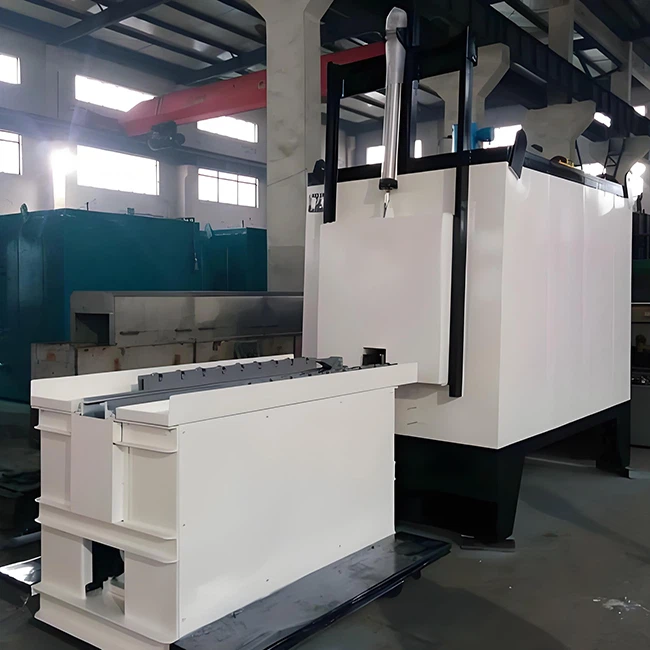
We offer a wide range of tempering furnaces, including the Atmosphere Protection Box Type Tempering Furnace, the Trolley Tempering Furnace, and the Pit Type Tempering Furnace. Each of these furnaces is designed to provide precise temperature control and uniform heating, ensuring that your metal is tempered to perfection.
Our Atmosphere Protection Box Type Tempering Furnace is ideal for applications that require a controlled atmosphere, such as the heat treatment of stainless steel and other alloys. The furnace is equipped with an atmosphere protection system that prevents oxidation and decarburization, ensuring that your metal retains its properties.
The Trolley Tempering Furnace is a versatile option that can handle large and heavy workpieces. It features a trolley that can be loaded and unloaded easily, making it suitable for high-volume production. The furnace is also equipped with a powerful heating system that provides fast and uniform heating.
The Pit Type Tempering Furnace is designed for applications that require vertical loading and unloading. It's ideal for long and slender workpieces, such as shafts and rods. The furnace is equipped with a pit that allows the workpiece to be immersed in the heating chamber, providing excellent heat transfer and uniform heating.
In conclusion, the quenching process before tempering plays a crucial role in the heat treatment of metals. It hardens the metal, creates a uniform structure, prepares the metal for tempering, and controls the phase transformation. By using our high-quality tempering furnaces, you can ensure that your metal is tempered to perfection, resulting in improved mechanical properties and performance.
If you're interested in learning more about our tempering furnaces or have any questions about the quenching and tempering process, please don't hesitate to contact us. We'd be happy to help you find the right solution for your needs.
References
- ASM Handbook, Volume 4: Heat Treating, ASM International
- Metals Handbook: Properties and Selection: Irons, Steels, and High-Performance Alloys, ASM International
- Heat Treating Principles and Processes, Robert L. Boyer