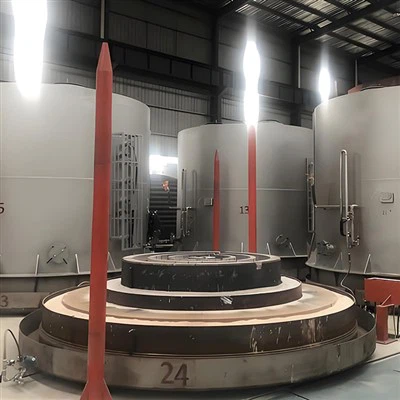
Hey there! As an aging furnace supplier, I've seen a lot of folks scratching their heads over the differences between batch and continuous aging furnaces. So, I thought I'd break it down for you in a way that's easy to understand.
Let's start with batch aging furnaces. These bad boys are like the slow - cooked meals of the heat - treatment world. You load up your parts into the furnace all at once, set the temperature and time, and let it do its thing. Once the cycle is complete, you take out the fully aged parts and then start the whole process over again with a new batch.
One of the big advantages of batch aging furnaces is their flexibility. You can easily adjust the temperature, time, and other parameters for each batch. This is super handy if you're dealing with different types of materials or parts that require unique aging processes. For example, if you're working on some Trolley Type Aluminum Alloy Aging Furnace, you might need a different aging profile compared to an aluminum wire. With a batch furnace, you can customize each run to get the best results.
Another plus is that batch furnaces are great for small - scale production. If you don't have a high volume of parts to age, or if you're still in the testing phase, a batch furnace is a cost - effective option. You don't have to invest in a large, continuous system right off the bat.
However, batch furnaces also have their drawbacks. The biggest one is the downtime between batches. Every time you finish a cycle, you have to open the furnace, unload the parts, load new ones, and then heat up the furnace again. This can eat into your production time and increase energy consumption. Also, if you need a high - volume output, batch furnaces might not be able to keep up.
Now, let's talk about continuous aging furnaces. These are the assembly - line workers of the aging furnace world. Parts are fed into the furnace one after another, and they move through the furnace at a constant speed. The temperature and other conditions are maintained continuously along the length of the furnace.
The main advantage of continuous aging furnaces is their high production rate. Since there's no downtime between batches, you can keep the furnace running 24/7 if you need to. This makes them ideal for large - scale production. If you're a big manufacturer churning out tons of Aluminum Wire Aging Furnace components, a continuous furnace can help you meet your production targets.
Continuous furnaces are also more energy - efficient in the long run. Once the furnace reaches the operating temperature, it doesn't have to be heated up and cooled down repeatedly like a batch furnace. This can lead to significant energy savings over time.
But continuous furnaces aren't perfect either. They lack the flexibility of batch furnaces. Once the furnace is set up for a particular process, it's not easy to change the parameters quickly. If you need to switch between different types of parts or aging processes, it can be a hassle. Also, continuous furnaces are generally more expensive to install and maintain. You need a more complex control system and a larger space to accommodate the continuous conveyor system.
In terms of construction and design, batch furnaces are usually smaller and more compact. They can be as simple as a Box Type Aging Furnace, which is easy to install in a small workshop. Continuous furnaces, on the other hand, are often larger and more complex. They require a dedicated area with proper ventilation and a conveyor system to move the parts through the furnace.
When it comes to quality control, batch furnaces give you more hands - on control. You can inspect each batch individually before moving on to the next one. This allows you to catch any quality issues early on. In continuous furnaces, quality control is more about monitoring the process continuously. You need to have sensors and monitoring systems in place to ensure that the parts are being aged correctly as they move through the furnace.


So, which one should you choose? Well, it depends on your specific needs. If you're a small - scale producer, or if you need to age different types of parts with unique requirements, a batch aging furnace might be the way to go. On the other hand, if you're a large - scale manufacturer with a high - volume production demand, a continuous aging furnace could be your best bet.
As an aging furnace supplier, I've helped many customers make this decision. I understand that every business is different, and I'm here to provide you with the best solution for your needs. Whether you're interested in a batch or continuous aging furnace, I can offer you a range of options with top - notch quality and performance.
If you're thinking about purchasing an aging furnace, don't hesitate to reach out. We can have a detailed discussion about your production requirements, budget, and any other concerns you might have. I'm confident that together, we can find the perfect aging furnace for your business.
References
- Heat Treatment Handbook: Principles and Processes. ASM International.
- Industrial Furnaces: Design, Operation, and Efficiency. John Wiley & Sons.