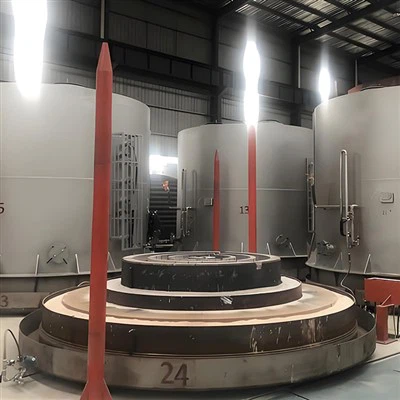
Hey there! As a pit furnace supplier, I often get asked, "Can a pit furnace be used for nitriding?" Well, let's dive right into this topic and find out.
First off, let's understand what nitriding is. Nitriding is a heat - treatment process where nitrogen is introduced into the surface of a metal to create a hard, wear - resistant layer. This process is commonly used on steels, but can also be applied to other metals like titanium and aluminum. It offers several benefits such as improved fatigue resistance, reduced friction, and enhanced corrosion resistance.
Now, let's talk about pit furnaces. Pit furnaces are vertical furnaces that are set into the ground or a pit. They come in different types and sizes, and are used for a variety of heat - treatment processes. We offer some great options like the All Fiber Pit Furnace, Medium Temperature Pit Furnace, and Pit Type Heat Treatment Furnace.
So, can a pit furnace be used for nitriding? The answer is yes! Pit furnaces can be effectively used for nitriding, and here's why.
Advantages of Using a Pit Furnace for Nitriding
1. Uniform Heating
One of the key requirements for nitriding is uniform heating of the workpiece. Pit furnaces are designed to provide excellent temperature uniformity. The vertical design allows for a more even distribution of heat around the workpiece. The heating elements in a pit furnace are usually arranged in a way that ensures consistent heat transfer to all parts of the load. This is crucial for nitriding because if the temperature is not uniform, the nitrogen diffusion will be uneven, resulting in an inconsistent nitride layer.


2. Space - Saving
Pit furnaces are a great space - saving option. Since they are installed vertically into the ground or a pit, they take up less floor space compared to horizontal furnaces. This is especially beneficial for workshops or manufacturing facilities where space is at a premium. You can have a large - capacity pit furnace in a relatively small area, allowing you to carry out nitriding operations without sacrificing valuable workspace.
3. Ease of Loading and Unloading
Loading and unloading workpieces in a pit furnace is relatively easy. The vertical orientation allows for simple crane or hoist - assisted loading, which is particularly useful when dealing with heavy or large - sized workpieces. This ease of handling is important for nitriding processes, as it reduces the time and effort required to prepare the furnace for each batch of workpieces.
4. Customization
Pit furnaces can be highly customized to meet the specific requirements of nitriding. You can adjust the temperature range, heating rate, and atmosphere control according to the type of metal and the desired nitride layer properties. For example, some metals may require a specific temperature profile during nitriding, and a pit furnace can be programmed to follow that profile precisely.
Types of Nitriding in Pit Furnaces
There are different types of nitriding processes that can be carried out in pit furnaces:
1. Gas Nitriding
Gas nitriding is the most common type of nitriding process. In gas nitriding, ammonia gas is introduced into the furnace at a specific temperature. The ammonia decomposes on the surface of the workpiece, releasing nitrogen atoms which diffuse into the metal. Pit furnaces can be equipped with gas - injection systems to control the flow and distribution of ammonia gas. The uniform temperature distribution in a pit furnace ensures that the gas nitriding process occurs evenly across the workpiece.
2. Plasma Nitriding
Plasma nitriding is another option. In this process, a plasma is created in the furnace using an electrical discharge. The plasma contains nitrogen ions that are accelerated towards the workpiece surface, resulting in nitrogen diffusion. Pit furnaces can be modified to accommodate plasma - nitriding equipment. The vertical design of the pit furnace allows for a stable plasma environment, which is essential for consistent nitriding results.
Considerations When Using a Pit Furnace for Nitriding
1. Atmosphere Control
Proper atmosphere control is crucial for nitriding. The furnace must be able to maintain a specific gas composition and pressure during the process. For gas nitriding, the ammonia - to - hydrogen ratio needs to be carefully controlled. In plasma nitriding, the plasma parameters such as voltage, current, and gas flow rate must be optimized. Our pit furnaces can be equipped with advanced atmosphere - control systems to ensure precise control of these parameters.
2. Temperature Control
As mentioned earlier, uniform temperature is essential for nitriding. You need to ensure that the pit furnace has accurate temperature sensors and a reliable heating control system. The furnace should be able to maintain the set temperature within a narrow tolerance range throughout the nitriding process.
3. Workpiece Cleaning
Before nitriding, the workpieces must be thoroughly cleaned to remove any contaminants such as oil, grease, or oxides. Contaminants can prevent proper nitrogen diffusion and result in a poor - quality nitride layer. Make sure to follow a proper cleaning procedure before loading the workpieces into the pit furnace.
Real - World Applications
Pit - furnace nitriding is used in a wide range of industries. In the automotive industry, nitrided components such as gears, crankshafts, and camshafts are used to improve their wear resistance and durability. In the aerospace industry, nitriding is applied to turbine blades and other critical components to enhance their performance under high - stress conditions.
Conclusion
In conclusion, a pit furnace can definitely be used for nitriding. It offers many advantages such as uniform heating, space - saving, ease of loading and unloading, and customization. Whether you're doing gas nitriding or plasma nitriding, a pit furnace can be a great choice for your nitriding needs.
If you're interested in using a pit furnace for nitriding in your manufacturing process, we'd love to have a chat with you. Our team of experts can help you choose the right pit furnace and provide you with all the necessary support to ensure successful nitriding operations. Don't hesitate to reach out and start a conversation about your requirements.
References
- ASM Handbook, Volume 4: Heat Treating, ASM International.
- "Nitriding of Metals" by G. E. Totten and M. A. Howes.
- "Heat Treatment Furnaces: Design and Operations" by J. F. Elliott.