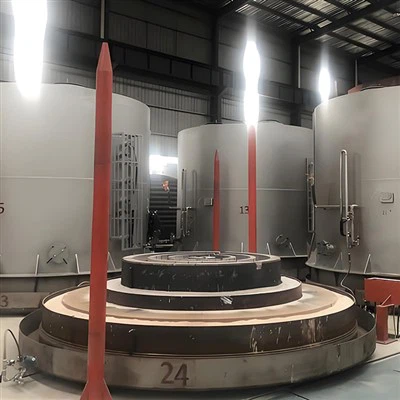
Hey there! As a nitriding furnace supplier, I've seen firsthand how these amazing pieces of equipment can have a huge impact on the properties of metals, especially their ductility. In this blog, I'm gonna break down how a nitriding furnace affects the ductility of metals and why it matters.
First off, let's talk about what ductility is. Ductility is a measure of a metal's ability to deform under tensile stress without breaking. In simpler terms, it's how much you can stretch a metal before it snaps. Metals with high ductility can be drawn into wires or hammered into thin sheets, while those with low ductility are more brittle and prone to cracking.
Now, how does a nitriding furnace come into play? Well, nitriding is a heat treatment process that involves introducing nitrogen into the surface of a metal. This is done by heating the metal in a nitrogen-rich environment, usually in a nitriding furnace. There are different types of nitriding furnaces, such as the Ion Nitriding Furnace and the Pit Type Nitriding Furnace, each with its own advantages and applications.
When a metal is nitrided, the nitrogen atoms diffuse into the surface layer of the metal, forming nitride compounds. These nitride compounds can have a significant impact on the metal's properties, including its ductility.
One of the main ways nitriding affects ductility is by hardening the surface of the metal. The nitride compounds that form on the surface are very hard and can increase the wear resistance and hardness of the metal. However, this hardening can also make the surface layer more brittle, which can reduce the overall ductility of the metal.
On the other hand, nitriding can also have some positive effects on ductility. For example, the introduction of nitrogen can refine the grain structure of the metal. A finer grain structure generally leads to better mechanical properties, including improved ductility. When the grains are smaller, there are more grain boundaries, which can act as barriers to the movement of dislocations (defects in the crystal structure of the metal). This can prevent the rapid propagation of cracks and improve the metal's ability to deform without breaking.
Another factor to consider is the depth of the nitrided layer. If the nitrided layer is too thick, it can have a more significant negative impact on ductility. A thick nitrided layer can create a large difference in hardness between the surface and the core of the metal, which can lead to stress concentrations and cracking. However, if the nitriding process is carefully controlled to produce a thin and uniform nitrided layer, the negative effects on ductility can be minimized while still achieving the desired improvements in wear resistance and hardness.
The choice of nitriding process and furnace also plays a role in how it affects ductility. For instance, ion nitriding is a more precise and controllable process compared to some other nitriding methods. With ion nitriding, the nitrogen ions are accelerated towards the metal surface using an electric field. This allows for better control over the nitriding parameters, such as the nitrogen concentration and the depth of the nitrided layer. As a result, it's possible to achieve a more optimal balance between improving the surface properties and maintaining the ductility of the metal.


Let's take a look at some real - world examples. In the automotive industry, nitriding is often used to treat engine components such as crankshafts and camshafts. These components need to have high wear resistance to withstand the high - stress operating conditions. However, they also need to have sufficient ductility to absorb the shock and vibration during engine operation. By using a nitriding furnace to carefully control the nitriding process, manufacturers can ensure that these components have the right combination of hardness and ductility.
In the aerospace industry, nitriding is used to treat parts made from titanium alloys. Titanium alloys are known for their high strength - to - weight ratio, but they can be relatively brittle. Nitriding can improve the surface hardness of titanium alloy parts, but it's crucial to ensure that the ductility is not significantly reduced. The Nitrogen Protection Copper Bright Annealing Furnace can also be used in related processes to further optimize the properties of the metals.
So, how can you make the most of nitriding furnaces to control the ductility of metals? First of all, it's important to work with a knowledgeable supplier. As a nitriding furnace supplier, I can offer advice on the best type of furnace and nitriding process for your specific application. We can help you determine the optimal nitriding parameters, such as the temperature, time, and nitrogen flow rate, to achieve the desired balance between hardness and ductility.
Secondly, it's essential to conduct thorough testing and quality control. Before mass - producing nitrided parts, it's a good idea to perform tests on sample parts to evaluate their ductility and other mechanical properties. This can help you make any necessary adjustments to the nitriding process.
If you're in the market for a nitriding furnace or need more information on how to use nitriding to control the ductility of your metals, don't hesitate to get in touch. We're here to help you find the best solutions for your business. Whether you're looking for an ion nitriding furnace, a pit - type nitriding furnace, or other related equipment, we've got you covered. Let's work together to take your metal - treating processes to the next level.
References
- Smith, J. (2018). "Fundamentals of Metal Heat Treatment". Publisher: Metal Press.
- Johnson, R. (2020). "Advanced Nitriding Techniques for Improved Metal Properties". Journal of Metallurgy, 25(3), 123 - 135.
- Brown, T. (2019). "The Impact of Nitriding on the Mechanical Properties of Metals". Proceedings of the International Conference on Metal Processing, 45 - 56.