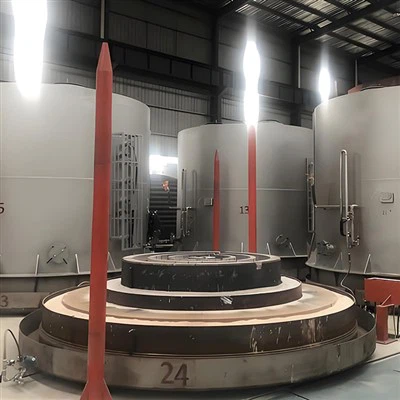
Hey there! As a supplier of Bell Annealing Furnaces, I often get asked if it's possible to anneal stainless steel in a Bell Annealing Furnace. Well, the short answer is yes, it is possible, and in this blog post, I'm gonna dive deep into the details of how and why.
First off, let's talk a bit about what annealing is. Annealing is a heat treatment process that involves heating a material to a specific temperature and then cooling it at a controlled rate. This process is used to relieve internal stresses, increase ductility, and improve the material's overall properties. For stainless steel, annealing can also enhance its corrosion resistance and make it easier to machine.
Now, let's get to the Bell Annealing Furnace. A Bell Annealing Furnace is a type of batch furnace that consists of a base and a removable bell-shaped cover. The material to be annealed is placed on the base, and the bell is lowered over it. The furnace can be heated using various methods, such as gas or electricity, and it allows for precise control of the temperature and the cooling rate.


So, why is a Bell Annealing Furnace suitable for annealing stainless steel? One of the main advantages is its ability to provide a uniform temperature distribution. Stainless steel is a sensitive material, and uneven heating can lead to issues like warping and inconsistent properties. The design of the Bell Annealing Furnace ensures that the heat is evenly distributed around the material, which helps to achieve a more consistent annealing result.
Another benefit is the controlled cooling rate. After the stainless steel has been heated to the appropriate annealing temperature, it needs to be cooled at a specific rate to achieve the desired properties. The Bell Annealing Furnace allows for this controlled cooling, which can be adjusted depending on the type of stainless steel and the specific requirements of the annealing process.
Let's take a closer look at the steps involved in annealing stainless steel in a Bell Annealing Furnace. The first step is to prepare the stainless steel. This may involve cleaning the material to remove any dirt, oil, or other contaminants that could affect the annealing process. Once the material is clean, it is placed on the base of the furnace.
Next, the bell is lowered over the material, and the furnace is heated to the annealing temperature. The annealing temperature for stainless steel can vary depending on the type of stainless steel and the desired properties. For example, austenitic stainless steels typically require an annealing temperature in the range of 1010 - 1120°C (1850 - 2050°F).
Once the material has reached the annealing temperature, it is held at that temperature for a certain period of time to allow for the internal stresses to be relieved and the microstructure to change. This holding time can also vary depending on the size and thickness of the material.
After the holding time is complete, the furnace is cooled at a controlled rate. This can be done by either natural cooling or by using a cooling system. The cooling rate is crucial, as it affects the final properties of the stainless steel. A slow cooling rate is often preferred for stainless steel to avoid the formation of hard and brittle phases.
Now, let's talk about some of the different types of Bell Annealing Furnaces that are available. We offer a Mobile Bell Type Furnace, which is a great option for applications where flexibility is needed. This type of furnace can be easily moved around the factory floor, allowing for quick and efficient annealing of different batches of stainless steel.
We also have a Split Mobile Bell Furnace. This furnace is designed with a split bell, which makes it easier to load and unload large or irregularly shaped pieces of stainless steel. The split design also allows for better access to the material during the annealing process.
Of course, like any heat treatment process, annealing stainless steel in a Bell Annealing Furnace does come with some challenges. One of the main challenges is ensuring that the furnace is properly maintained. Regular maintenance is essential to ensure that the furnace is operating at its optimal performance and to prevent any issues that could affect the annealing process.
Another challenge is the cost. Bell Annealing Furnaces can be relatively expensive to purchase and operate. However, when you consider the benefits of annealing stainless steel, such as improved properties and increased productivity, the investment can be well worth it in the long run.
In conclusion, it is definitely possible to anneal stainless steel in a Bell Annealing Furnace. The furnace's ability to provide a uniform temperature distribution and a controlled cooling rate makes it an ideal choice for this type of heat treatment. Whether you're looking for a standard Bell Annealing Furnace or a more specialized option like a Mobile Bell Type Furnace or a Split Mobile Bell Furnace, we've got you covered.
If you're interested in annealing stainless steel or have any questions about our Bell Annealing Furnaces, don't hesitate to reach out. We're here to help you find the right solution for your specific needs. Let's start a conversation and see how we can work together to improve your stainless steel annealing process.
References
- "Heat Treatment of Stainless Steels" - ASM International Handbook
- "Bell Annealing Furnaces: Design and Operation" - Industrial Heating Magazine