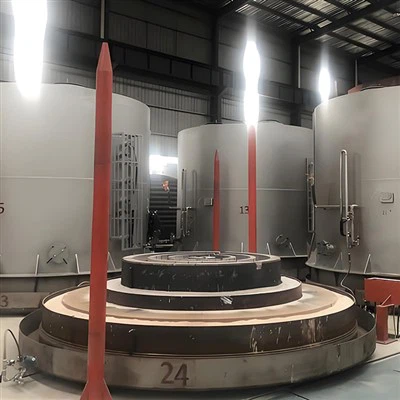
Hey there! As a supplier of annealing furnaces, I've seen firsthand how these amazing pieces of equipment can transform the properties of metals. One of the most significant effects of annealing in an annealing furnace is on the hardness of metals. In this blog, I'll dive deep into what annealing is, how it affects metal hardness, and why our annealing furnaces are the top choice for your metal - treating needs.
What is Annealing?
Before we talk about how annealing affects metal hardness, let's quickly go over what annealing actually is. Annealing is a heat - treatment process that involves heating a metal to a specific temperature, holding it at that temperature for a set period, and then cooling it at a controlled rate. This process helps to relieve internal stresses, increase ductility, and improve the overall machinability of the metal.
There are different types of annealing processes, such as full annealing, process annealing, and stress - relief annealing. Each type has its own specific temperature range and cooling rate, which are tailored to achieve different results.
How Annealing Affects Metal Hardness
Softening the Metal
The most common effect of annealing on metal hardness is softening. When a metal is heated during the annealing process, the atoms within the metal lattice gain energy and start to move more freely. This movement allows the dislocations (imperfections in the crystal structure) to rearrange and reduce in number. As a result, the metal becomes more ductile and less hard.
For example, in the case of steel, full annealing can significantly reduce its hardness. Steel that has been through a full annealing process is much easier to machine, form, and shape. This is because the softened metal can deform more easily under stress without cracking or breaking.
Grain Refinement
Another way annealing affects metal hardness is through grain refinement. During annealing, the metal's grains can grow or shrink depending on the heating and cooling conditions. In some cases, a carefully controlled annealing process can lead to the formation of smaller, more uniform grains.
Smaller grains generally mean higher hardness and strength. This is because the boundaries between the grains act as barriers to the movement of dislocations. When the grains are smaller, there are more grain boundaries, which makes it more difficult for dislocations to move. As a result, the metal becomes harder and stronger.
Stress Relief
Annealing is also used for stress relief. Metals often develop internal stresses during manufacturing processes such as casting, forging, or machining. These internal stresses can cause the metal to warp, crack, or have inconsistent hardness.
By heating the metal to a specific temperature during annealing, the internal stresses are relieved. Once the stresses are removed, the metal's hardness becomes more uniform. This is especially important for applications where precise hardness and dimensional stability are required.
Types of Annealing Furnaces We Offer
Trolley Annealing Furnace
Our Trolley Annealing Furnace is a great option for large - scale annealing operations. It features a movable trolley that allows for easy loading and unloading of large workpieces. The furnace provides uniform heating, which is crucial for achieving consistent annealing results and controlling the hardness of the metals.
Roller Annealing Furnace
The Roller Annealing Furnace is designed for continuous annealing of long and flat metal products, such as sheets and strips. The rollers inside the furnace transport the metal through the heating and cooling zones, ensuring a smooth and efficient annealing process. This type of furnace is ideal for industries that require high - volume production with precise control over metal hardness.
Vacuum Annealing Furnace
Our Vacuum Annealing Furnace offers a unique advantage for annealing metals that are sensitive to oxidation. In a vacuum environment, the metal is protected from the effects of oxygen, which can cause surface scaling and other defects. This results in a cleaner and more precise annealing process, leading to better control over the metal's hardness and other properties.
Factors to Consider When Choosing an Annealing Furnace
Temperature Control
Accurate temperature control is essential for achieving the desired effect on metal hardness. Our annealing furnaces are equipped with advanced temperature control systems that can maintain a stable temperature within a very narrow range. This ensures that the annealing process is consistent and repeatable, resulting in uniform hardness across all the treated metal parts.
Cooling Rate
The cooling rate is another critical factor in the annealing process. Different metals require different cooling rates to achieve the desired hardness. Our furnaces allow for precise control of the cooling rate, whether it's a slow, controlled cooling for softening the metal or a rapid cooling for grain refinement.

Capacity
Depending on your production needs, you'll need to choose an annealing furnace with the right capacity. We offer a wide range of furnace sizes, from small - scale units for laboratory use to large - scale industrial furnaces for high - volume production.
Why Choose Our Annealing Furnaces
Quality and Reliability
Our annealing furnaces are built to the highest quality standards. We use only the best materials and components in the manufacturing process to ensure long - term reliability and performance. Our furnaces are designed to withstand the harsh conditions of industrial use and provide consistent results over many years.
Customization
We understand that every customer has unique requirements. That's why we offer customization options for our annealing furnaces. Whether you need a specific size, temperature range, or control system, we can tailor our furnaces to meet your exact needs.
Technical Support
We provide comprehensive technical support to our customers. Our team of experts is always available to answer your questions, offer advice on the annealing process, and help you troubleshoot any issues that may arise.
Conclusion
Annealing in an annealing furnace has a profound effect on the hardness of metals. Whether you're looking to soften a metal for easier machining or achieve a specific hardness level through grain refinement, the right annealing process can make all the difference.
As a leading supplier of annealing furnaces, we offer a wide range of high - quality furnaces that are designed to meet the diverse needs of the metal - treating industry. Our Trolley Annealing Furnace, Roller Annealing Furnace, and Vacuum Annealing Furnace are all equipped with the latest technology to ensure precise control over the annealing process and consistent results.
If you're in the market for an annealing furnace or have any questions about how annealing affects metal hardness, don't hesitate to get in touch. We're here to help you make the right choice for your metal - treating needs.
References
- ASM Handbook Volume 4: Heat Treating. ASM International.
- Metals Handbook: Properties and Selection: Irons and Steels. ASM International.