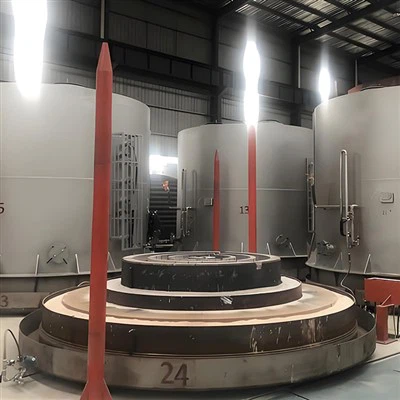
Hey there! As a supplier of tempering furnaces, I've seen firsthand how the tempering time can have a huge impact on the material properties of the stuff we're working with. So, let's dig into what those impacts are and why they matter.
First off, let's quickly go over what tempering is. Tempering is a heat treatment process that follows hardening. After a material, usually metal, is hardened, it's often very brittle. Tempering helps to reduce that brittleness and improve other properties like toughness, ductility, and strength. And the time the material spends in the tempering furnace plays a crucial role in all of this.


One of the most significant impacts of tempering time is on the hardness of the material. Generally, as the tempering time increases, the hardness of the material decreases. This is because during tempering, the internal stresses in the material are relieved, and the microstructure changes. The longer the tempering time, the more these changes occur, leading to a softer material. For example, if you're working with steel, a short tempering time might result in a steel that's still quite hard, which could be great for applications where high hardness is needed, like cutting tools. But if you increase the tempering time, the steel will become less hard but more ductile, making it suitable for applications where it needs to bend or deform without breaking, like springs.
Toughness is another property that's affected by tempering time. Toughness is the ability of a material to absorb energy and deform plastically before fracturing. When you increase the tempering time, the toughness of the material usually goes up. This is because the relief of internal stresses and the change in microstructure make the material more resistant to crack propagation. A material with high toughness can withstand impacts and shocks without failing, which is super important in many engineering applications. For instance, in the automotive industry, parts like axles and crankshafts need to have high toughness to handle the stresses of daily use.
Ductility is also closely related to tempering time. Ductility is the ability of a material to be stretched or drawn into a wire without breaking. Similar to toughness, ductility generally increases with longer tempering times. The changes in the microstructure during tempering allow the material to deform more easily under stress. This is useful in manufacturing processes like forging and rolling, where the material needs to be shaped without cracking. For example, in the production of wires and cables, a ductile material is essential to ensure that it can be drawn into the desired shape.
Now, let's talk about how different types of tempering furnaces can affect the relationship between tempering time and material properties. We offer a variety of tempering furnaces, each with its own advantages.
The Pit Type Tempering Furnace is great for large and heavy workpieces. It provides a uniform temperature distribution, which is crucial for consistent material properties. The design of the pit type furnace allows for efficient heat transfer, which can reduce the overall tempering time while still achieving the desired results. This means you can save time and energy without sacrificing the quality of the material.
The Atmosphere Protection Box Type Tempering Furnace is ideal for materials that are sensitive to oxidation. By creating a controlled atmosphere inside the furnace, it prevents the material from reacting with oxygen and forming oxides on the surface. This is especially important when you're working with high - value materials or when you need a clean and smooth surface finish. The atmosphere protection also allows for more precise control of the tempering process, which can have a positive impact on the material properties.
The Mesh Belt Tempering Furnace is a continuous - type furnace that's great for mass production. It has a high throughput, which means you can temper a large number of parts in a relatively short time. The mesh belt design allows for good heat transfer and uniform heating of the parts. This type of furnace can be adjusted to control the tempering time precisely, making it suitable for a wide range of materials and applications.
However, it's important to note that there's a balance when it comes to tempering time. If you temper a material for too long, you might over - temper it. Over - tempering can lead to a significant loss of hardness and strength, which might not be desirable for certain applications. So, it's crucial to find the right tempering time based on the specific material and the requirements of the end - product.
In conclusion, the tempering time has a profound impact on the material properties of the stuff we're tempering. By carefully controlling the tempering time and choosing the right type of tempering furnace, you can achieve the perfect balance of hardness, toughness, and ductility for your application. Whether you're in the manufacturing, automotive, or aerospace industry, getting these material properties right is essential for the success of your products.
If you're interested in learning more about our tempering furnaces or need help in determining the best tempering process for your materials, don't hesitate to reach out. We're here to assist you in getting the most out of your heat treatment processes.
References
- Callister, W. D., & Rethwisch, D. G. (2011). Materials Science and Engineering: An Introduction. Wiley.
- ASM Handbook Committee. (1991). ASM Handbook Volume 4: Heat Treating. ASM International.