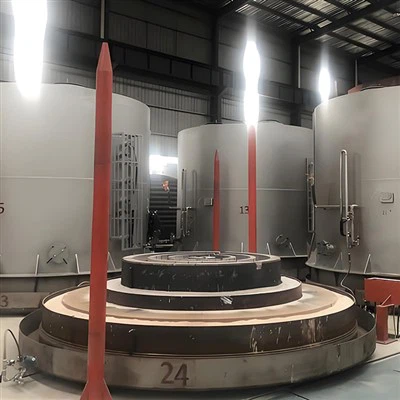
What is the carburizing quality control in a pit furnace?
As a supplier of Carburizing Pit Furnaces, I've had the privilege of witnessing firsthand the critical role that carburizing quality control plays in the heat treatment industry. Carburizing is a thermochemical process used to increase the carbon content of the surface layer of a metal, typically steel, to enhance its hardness, wear resistance, and fatigue strength. A pit furnace is a specialized type of furnace that is well - suited for carburizing due to its vertical design, which allows for efficient use of space and easy loading and unloading of large or long workpieces.
Understanding the Carburizing Process in a Pit Furnace
The carburizing process in a pit furnace generally involves three main stages: heating, carburizing, and diffusion. In the heating stage, the workpiece is heated to a temperature where carbon can diffuse into the metal lattice. This temperature usually ranges from 850°C to 950°C (1562°F to 1742°F). During the carburizing stage, a carbon - rich atmosphere is introduced into the furnace. This can be achieved through various methods, such as using gas carburizing agents like propane or natural gas, or by using solid carburizing media. The carbon atoms from the atmosphere diffuse into the surface of the workpiece, forming a high - carbon layer.
After the carburizing stage, the diffusion stage begins. In this stage, the furnace temperature is maintained, and the carbon atoms that have diffused into the surface layer are allowed to redistribute within the metal to achieve a more uniform carbon concentration gradient. This is crucial for ensuring the desired mechanical properties of the carburized part.
Key Factors in Carburizing Quality Control
Temperature Control
Temperature is one of the most critical factors in carburizing quality control. A precise and uniform temperature distribution within the pit furnace is essential for consistent carburizing results. Fluctuations in temperature can lead to uneven carbon diffusion, resulting in parts with inconsistent hardness and wear resistance. Modern pit furnaces are equipped with advanced temperature control systems, such as thermocouples and programmable logic controllers (PLCs), to monitor and adjust the temperature accurately. These systems can maintain the temperature within a narrow range, typically ±5°C (±9°F), ensuring reliable carburizing performance.
Carbon Potential Control
The carbon potential of the carburizing atmosphere is another vital factor. Carbon potential refers to the ability of the atmosphere to transfer carbon to the workpiece surface. It is determined by the type and concentration of the carburizing agents, as well as the furnace temperature and pressure. Maintaining the correct carbon potential is crucial for achieving the desired carbon content in the carburized layer. Too high a carbon potential can lead to the formation of excessive carbides on the surface, which can reduce the toughness of the part. On the other hand, too low a carbon potential may result in insufficient carbon diffusion and a low - carbon surface layer.
To control the carbon potential, continuous monitoring and adjustment are required. This can be done using sensors, such as oxygen probes, which measure the oxygen content in the furnace atmosphere. Based on the oxygen content, the carbon potential can be calculated and adjusted by controlling the flow rate of the carburizing agents.
Time Control
The duration of the carburizing and diffusion stages also significantly affects the carburizing quality. The carburizing time determines the depth of the carbon - rich layer, while the diffusion time affects the carbon concentration gradient within the layer. If the carburizing time is too short, the carbon layer may be too thin to provide the desired wear resistance. Conversely, if the carburizing time is too long, the part may experience excessive grain growth, which can reduce its mechanical properties.
Proper time control is achieved through careful process planning and optimization. The carburizing and diffusion times are determined based on factors such as the type of steel, the desired carbon layer depth, and the furnace operating conditions.
Workpiece Loading and Fixturing
The way the workpieces are loaded and fixtured in the pit furnace can also impact the carburizing quality. Uneven loading can lead to non - uniform heat transfer and carbon diffusion. Workpieces should be arranged in a way that allows for proper circulation of the carburizing atmosphere around each part. Fixtures should be designed to hold the workpieces securely without obstructing the flow of the atmosphere.
Quality Assurance and Testing
To ensure the carburizing quality, a comprehensive quality assurance program should be in place. This includes in - process monitoring and post - process testing. During the carburizing process, the temperature, carbon potential, and other process parameters are continuously monitored to detect any deviations from the set values. If a deviation is detected, corrective actions can be taken immediately to prevent defective parts from being produced.


After the carburizing process, the parts are subjected to various tests to verify their quality. These tests may include hardness testing, metallographic analysis, and dimensional inspection. Hardness testing is used to measure the hardness of the carburized layer and the core of the part. Metallographic analysis involves examining the microstructure of the carburized layer under a microscope to check for the presence of carbides, grain size, and other microstructural features. Dimensional inspection ensures that the carburized parts meet the required dimensional tolerances.
Our Carburizing Pit Furnaces and Quality Control
At our company, we take pride in offering high - quality Carburizing Pit Furnaces that are designed to provide excellent carburizing quality control. Our furnaces are equipped with state - of - the - art temperature control systems, carbon potential sensors, and advanced PLCs to ensure precise and consistent operation. We also offer customized solutions to meet the specific needs of our customers.
In addition to our Carburizing Pit Furnace, we also supply Box Type Gas Carburizing Furnace, which is another popular option for carburizing applications. These box - type furnaces are suitable for smaller workpieces and offer similar high - quality carburizing performance.
Contact Us for Your Carburizing Needs
If you are in the market for a reliable carburizing furnace and need professional advice on carburizing quality control, we would be more than happy to assist you. Our team of experts has extensive experience in the heat treatment industry and can provide you with the best solutions for your specific requirements. Whether you are a small - scale manufacturer or a large - scale industrial enterprise, we have the right furnace and support services for you. Contact us today to start the procurement negotiation process and take your carburizing operations to the next level.
References
- Totten, G. E., & MacKenzie, D. S. (2004). Handbook of Engineering Properties of Carbon Steels. CRC Press.
- Liscic, B., & Totten, G. E. (2006). Quenching Theory and Technology. ASM International.
-ASM Handbook Committee. (1991). ASM Handbook, Volume 4: Heat Treating. ASM International.