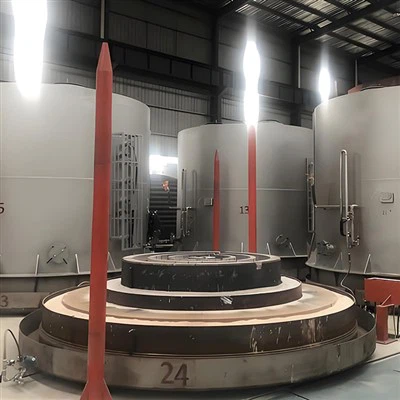
Heat treatment is a crucial process in material engineering, significantly influencing the mechanical properties of various materials. As a supplier of Pit Quenching Furnace, I have witnessed firsthand the transformative effects of heat treatment in a pit quenching furnace on the mechanical characteristics of materials. This blog aims to explore the impact of heat treatment in a pit quenching furnace on the mechanical properties of materials, delving into the underlying mechanisms and practical implications.
Understanding Pit Quenching Furnaces
A pit quenching furnace is a specialized equipment designed for heat treatment processes, particularly quenching. It consists of a vertical chamber, or "pit," where the material to be treated is placed. The furnace is equipped with heating elements to raise the temperature of the material to a specific level, followed by rapid cooling, or quenching, in a quenching medium such as oil, water, or polymer solution. This rapid cooling process is crucial for altering the microstructure of the material, thereby affecting its mechanical properties.
The design of a pit quenching furnace offers several advantages. Its vertical orientation allows for efficient use of space, making it suitable for large or long workpieces. The enclosed chamber provides better temperature control and uniformity, ensuring consistent heat treatment results. Additionally, the pit design facilitates the use of various quenching media, enabling customization of the heat treatment process based on the specific requirements of the material.
Effects of Heat Treatment on Mechanical Properties
Hardness
One of the most significant effects of heat treatment in a pit quenching furnace is the change in hardness. Hardness is a measure of a material's resistance to indentation or scratching. During the quenching process, the rapid cooling rate prevents the formation of equilibrium phases in the material. Instead, a supersaturated solid solution is formed, which can lead to the precipitation of fine particles or the formation of a martensitic structure, depending on the material composition.
For example, in steel, the transformation of austenite to martensite during quenching results in a significant increase in hardness. Martensite is a very hard and brittle phase, characterized by a highly distorted crystal structure. The hardness of the quenched steel can be further enhanced by subsequent tempering, a process that involves reheating the quenched material to a lower temperature to relieve internal stresses and improve toughness.
The Aluminum Alloy Quenching Furnace is commonly used for heat treating aluminum alloys. In aluminum alloys, the quenching process can also increase hardness by promoting the formation of fine precipitates. These precipitates impede the movement of dislocations, making the material more resistant to deformation.
Strength
Strength is another important mechanical property affected by heat treatment. It refers to the ability of a material to withstand an applied load without failure. Heat treatment can improve both the yield strength and the ultimate tensile strength of a material.
In the case of steel, the formation of martensite during quenching increases the yield strength significantly. The highly distorted crystal structure of martensite makes it difficult for dislocations to move, requiring a higher stress to initiate plastic deformation. However, the high hardness and brittleness of martensite can also lead to a decrease in ductility. Tempering can be used to balance the strength and ductility of the steel by reducing the internal stresses and modifying the microstructure.
For non-ferrous metals such as aluminum alloys, heat treatment can also enhance strength through precipitation hardening. During the solution treatment stage in an Aluminum Alloy Solution Treatment Furnace, the alloying elements are dissolved in the aluminum matrix. Quenching the material rapidly traps these elements in a supersaturated solid solution. Subsequent aging at a specific temperature allows the alloying elements to precipitate out as fine particles, which strengthen the material by impeding dislocation movement.
Ductility and Toughness
Ductility is the ability of a material to deform plastically before fracture, while toughness is the ability of a material to absorb energy and resist fracture. Heat treatment can have a complex effect on ductility and toughness, depending on the material and the heat treatment process.
As mentioned earlier, quenching can increase the hardness and strength of a material but may also reduce its ductility and toughness. The formation of martensite in steel, for example, can make the material brittle and prone to cracking. Tempering is often used to improve the ductility and toughness of quenched steel by reducing the internal stresses and modifying the microstructure.
In some cases, heat treatment can be designed to optimize both strength and ductility. For example, a process called ausforming involves deformation of the material in the austenitic state followed by quenching. This process can refine the microstructure and improve the combination of strength and ductility.
Fatigue Resistance
Fatigue is the failure of a material under repeated or cyclic loading. Heat treatment can significantly affect the fatigue resistance of a material. By improving the strength and hardness of the material, heat treatment can increase its resistance to crack initiation and propagation under cyclic loading.
For example, in steel components, the formation of a fine-grained microstructure through heat treatment can enhance fatigue resistance. Fine grains provide more barriers to dislocation movement, making it more difficult for cracks to initiate and grow. Additionally, the residual compressive stresses introduced during heat treatment can also improve fatigue resistance by counteracting the tensile stresses generated during cyclic loading.
Factors Affecting the Heat Treatment Process
Several factors can influence the effectiveness of heat treatment in a pit quenching furnace and the resulting mechanical properties of the material.
Heating Rate
The heating rate determines how quickly the material reaches the desired heat treatment temperature. A slow heating rate allows for more uniform heating and can reduce the risk of thermal stress and cracking. However, a very slow heating rate may also lead to grain growth, which can have a negative impact on the mechanical properties of the material. On the other hand, a fast heating rate can minimize grain growth but may increase the risk of thermal shock.
Quenching Rate
The quenching rate is a critical factor in determining the microstructure and mechanical properties of the material. A faster quenching rate generally leads to a harder and stronger material, but it also increases the risk of cracking and distortion. The choice of quenching medium and its cooling characteristics play a crucial role in controlling the quenching rate. For example, water quenching provides a very fast cooling rate, while oil quenching is slower. Polymer solutions can offer a range of cooling rates, depending on their concentration and temperature.
Holding Time
The holding time at the heat treatment temperature is important for ensuring complete transformation of the material. It allows for the diffusion of atoms and the formation of the desired phases. Insufficient holding time may result in incomplete transformation, while excessive holding time can lead to grain growth and other undesirable microstructural changes.


Material Composition
The composition of the material has a significant impact on its response to heat treatment. Different alloying elements can affect the phase transformations and the resulting microstructure during heat treatment. For example, in steel, the addition of elements such as carbon, chromium, and nickel can influence the hardenability, strength, and toughness of the material.
Practical Applications
The ability to control the mechanical properties of materials through heat treatment in a pit quenching furnace has numerous practical applications across various industries.
Automotive Industry
In the automotive industry, heat-treated components are widely used to improve the performance and reliability of vehicles. Engine parts such as crankshafts, camshafts, and connecting rods are often heat-treated to increase their strength and wear resistance. Transmission gears and axles are also heat-treated to enhance their fatigue resistance and durability.
Aerospace Industry
The aerospace industry demands materials with high strength-to-weight ratios and excellent fatigue resistance. Heat treatment in a pit quenching furnace is used to produce components such as aircraft landing gear, turbine blades, and structural parts. The ability to tailor the mechanical properties of these components through heat treatment is crucial for ensuring the safety and performance of aircraft.
Tool and Die Industry
In the tool and die industry, heat treatment is essential for producing high-quality cutting tools and dies. Tools such as drills, end mills, and taps are heat-treated to increase their hardness and wear resistance, allowing them to maintain sharp cutting edges for longer periods. Dies used in forging, stamping, and casting processes are also heat-treated to improve their strength and toughness, ensuring their durability under high-pressure and high-temperature conditions.
Conclusion
Heat treatment in a pit quenching furnace is a powerful tool for altering the mechanical properties of materials. By carefully controlling the heating, quenching, and tempering processes, it is possible to achieve a wide range of mechanical properties, including hardness, strength, ductility, toughness, and fatigue resistance. The ability to customize the heat treatment process based on the specific requirements of the material and the application makes pit quenching furnaces an essential piece of equipment in various industries.
As a supplier of Pit Quenching Furnace, we are committed to providing high-quality heat treatment solutions to our customers. Our pit quenching furnaces are designed to offer precise temperature control, uniform heating, and efficient quenching, ensuring consistent and reliable heat treatment results. If you are interested in learning more about our products or discussing your heat treatment requirements, please feel free to contact us. We look forward to the opportunity to collaborate with you and help you achieve the best possible mechanical properties for your materials.
References
- ASM Handbook, Volume 4: Heat Treating, ASM International, 1991.
- Callister, W. D., & Rethwisch, D. G. (2011). Materials Science and Engineering: An Introduction. Wiley.
- Llewellyn, D. T., & Baker, I. (2003). Steels: Metallurgy and Applications. Butterworth-Heinemann.