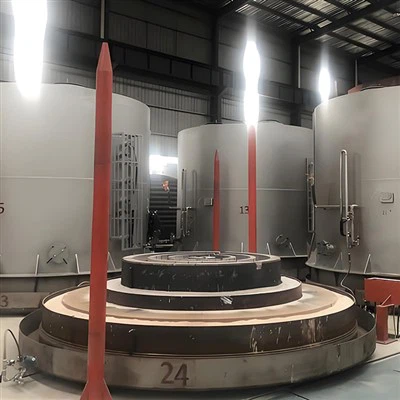
Can an Ion Nitriding Furnace be used for nitriding springs?


As a reputable supplier of Ion Nitriding Furnaces, I often encounter inquiries regarding the suitability of our equipment for specific applications. One such question that frequently arises is whether an Ion Nitriding Furnace can be used for nitriding springs. In this blog post, I will delve into this topic, exploring the feasibility, benefits, and considerations associated with using an Ion Nitriding Furnace for spring nitriding.
Understanding Ion Nitriding
Before we discuss the application of Ion Nitriding Furnaces to springs, it's essential to understand the process of ion nitriding itself. Ion nitriding, also known as plasma nitriding, is a thermochemical surface treatment process that enhances the surface properties of metals. It involves introducing nitrogen ions into the surface of a metal component under a low-pressure, gaseous environment. The nitrogen ions react with the metal to form nitrides, which significantly improve the hardness, wear resistance, corrosion resistance, and fatigue strength of the treated surface.
Ion nitriding offers several advantages over traditional nitriding methods, such as gas nitriding and salt bath nitriding. These advantages include precise control over the nitriding process, reduced processing time, lower energy consumption, and the ability to treat complex-shaped components without the need for masking. Additionally, ion nitriding produces a more uniform and adherent nitride layer, which results in better surface quality and performance.
Suitability of Ion Nitriding Furnaces for Spring Nitriding
Springs are critical components used in a wide range of applications, from automotive and aerospace to industrial machinery and consumer products. They are designed to store and release energy, providing elastic force and maintaining the desired shape and position of various mechanical systems. The performance and durability of springs depend on their material properties, design, and surface condition.
Nitriding is a common surface treatment used to improve the performance of springs. By forming a hard, wear-resistant nitride layer on the surface of the spring, nitriding can enhance its fatigue strength, corrosion resistance, and resistance to galling and scoring. This, in turn, can extend the service life of the spring and improve the reliability of the overall system.
So, can an Ion Nitriding Furnace be used for nitriding springs? The answer is yes. Ion nitriding is a highly effective method for nitriding springs, offering several benefits over traditional nitriding methods. Here are some of the key advantages of using an Ion Nitriding Furnace for spring nitriding:
- Precise Control: Ion nitriding allows for precise control over the nitriding process, including the temperature, gas composition, and nitriding time. This enables the formation of a uniform and consistent nitride layer on the surface of the spring, ensuring optimal performance and reliability.
- Reduced Distortion: Springs are often made of high-strength materials that are prone to distortion during heat treatment. Ion nitriding is a low-temperature process that minimizes the risk of distortion, allowing springs to maintain their original shape and dimensions.
- Improved Fatigue Strength: The nitride layer formed by ion nitriding can significantly improve the fatigue strength of springs, reducing the risk of failure due to cyclic loading. This is particularly important in applications where springs are subjected to high-stress conditions.
- Enhanced Corrosion Resistance: Ion nitriding can also improve the corrosion resistance of springs, protecting them from environmental factors such as moisture, chemicals, and salt spray. This is especially beneficial in applications where springs are exposed to harsh operating conditions.
- Versatility: Ion nitriding can be used to treat a wide range of spring materials, including carbon steel, alloy steel, stainless steel, and titanium. This makes it a versatile surface treatment option for springs used in various industries.
Considerations for Spring Nitriding in an Ion Nitriding Furnace
While ion nitriding is a suitable method for nitriding springs, there are several considerations that need to be taken into account to ensure successful treatment. Here are some of the key factors to consider:
- Material Selection: The choice of spring material is crucial for successful ion nitriding. Different materials have different nitriding characteristics, and the nitriding process parameters need to be adjusted accordingly. For example, some materials may require a pre-treatment or post-treatment to optimize the nitriding results.
- Spring Design: The design of the spring can also affect the nitriding process. Springs with complex shapes or tight tolerances may require special fixtures or masking to ensure uniform nitriding. Additionally, the spring's surface finish can impact the quality of the nitride layer, so it's important to ensure that the surface is clean and free of contaminants before nitriding.
- Nitriding Process Parameters: The nitriding process parameters, such as temperature, gas composition, and nitriding time, need to be carefully selected to achieve the desired nitride layer properties. These parameters can vary depending on the spring material, design, and application requirements. It's important to work with an experienced ion nitriding furnace supplier to determine the optimal process parameters for your specific application.
- Quality Control: Quality control is essential to ensure the consistency and reliability of the nitrided springs. This includes monitoring the nitriding process parameters, inspecting the nitride layer thickness and hardness, and conducting performance testing to verify the spring's performance.
Types of Ion Nitriding Furnaces for Spring Nitriding
At [Company Name], we offer a range of Ion Nitriding Furnaces that are suitable for nitriding springs. Our furnaces are designed to provide precise control over the nitriding process, ensuring consistent and high-quality results. Here are some of the types of Ion Nitriding Furnaces we offer:
- Ion Nitriding Furnace: Our standard Ion Nitriding Furnace is a versatile and cost-effective solution for nitriding springs. It features a compact design, easy operation, and precise temperature and gas control.
- Pit Type Nitriding Furnace: Our Pit Type Nitriding Furnace is ideal for nitriding large or heavy springs. It offers a large loading capacity and uniform temperature distribution, ensuring consistent nitriding results.
- Vacuum Nitriding Furnace: Our Vacuum Nitriding Furnace is designed for applications where a high level of cleanliness and precision is required. It provides a clean and controlled environment for nitriding, resulting in a high-quality nitride layer with excellent surface finish.
Conclusion
In conclusion, an Ion Nitriding Furnace can be effectively used for nitriding springs. Ion nitriding offers several advantages over traditional nitriding methods, including precise control, reduced distortion, improved fatigue strength, enhanced corrosion resistance, and versatility. However, it's important to consider the material selection, spring design, nitriding process parameters, and quality control to ensure successful treatment.
As a leading supplier of Ion Nitriding Furnaces, we have the expertise and experience to help you select the right furnace for your spring nitriding application. Our team of technical experts can provide you with customized solutions and support to ensure that you achieve the best possible results. If you're interested in learning more about our Ion Nitriding Furnaces or have any questions about spring nitriding, please don't hesitate to [Contact Us]. We look forward to working with you to improve the performance and durability of your springs.
References
- ASM Handbook, Volume 4: Heat Treating, ASM International, 1991.
- Surface Engineering for Corrosion and Wear Resistance, Edited by T.S. Sudarshan and M. Jeandin, Woodhead Publishing, 2003.
- Ion Nitriding: Principles and Applications, Edited by K. Bobzin and H. Kopp, Wiley-VCH, 2007.