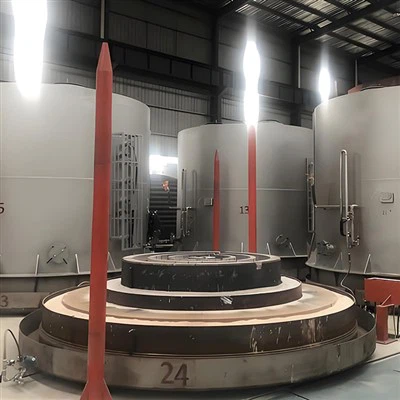
As a seasoned supplier of Box Type Aging Furnaces, I've witnessed firsthand the growing demand for precision heat treatment solutions in various industries. One common question that arises among our clients is the difference between standard and custom-built Box Type Aging Furnaces. In this blog post, I'll delve into the key distinctions, advantages, and considerations for each option to help you make an informed decision for your specific needs.
Understanding Box Type Aging Furnaces
Before we explore the differences between standard and custom-built models, let's briefly review what Box Type Aging Furnaces are and their applications. A Box Type Aging Furnace is a specialized industrial oven designed to subject materials to controlled heat treatment processes, typically for the purpose of improving their mechanical properties, such as hardness, strength, and dimensional stability. These furnaces are widely used in industries such as aerospace, automotive, electronics, and manufacturing to age metals, alloys, and composite materials.
Standard Box Type Aging Furnaces
Standard Box Type Aging Furnaces are pre-engineered models that are mass-produced to meet common industry requirements. These furnaces come with a set of predefined specifications, features, and configurations that are designed to provide a cost-effective and reliable solution for a wide range of applications. Here are some key characteristics of standard furnaces:
1. Cost-Effectiveness
One of the primary advantages of standard Box Type Aging Furnaces is their cost-effectiveness. Since these furnaces are mass-produced, the economies of scale allow for lower manufacturing costs, which are passed on to the customers. This makes standard furnaces an attractive option for businesses with budget constraints or those looking for a quick and affordable solution.
2. Quick Delivery
Another benefit of standard furnaces is their quick delivery time. Since these models are pre-engineered and readily available in stock, they can be shipped to the customer's location within a short period. This is particularly advantageous for businesses that need to start their heat treatment operations as soon as possible.
3. Standardized Features and Configurations
Standard Box Type Aging Furnaces come with a set of standardized features and configurations that are designed to meet the most common industry requirements. These features may include temperature control systems, heating elements, insulation materials, and safety devices. While these standard features may not be suitable for every application, they provide a good starting point for businesses that are looking for a basic heat treatment solution.
4. Limited Customization Options
One of the main limitations of standard Box Type Aging Furnaces is their limited customization options. Since these models are pre-engineered, they may not be able to meet the specific requirements of some applications. For example, if you need a furnace with a specific temperature range, size, or loading capacity, a standard furnace may not be able to accommodate your needs.
Custom-Built Box Type Aging Furnaces
Custom-built Box Type Aging Furnaces, on the other hand, are designed and manufactured to meet the specific requirements of individual customers. These furnaces are tailored to the unique needs of each application, taking into account factors such as the type of material being treated, the desired heat treatment process, and the production volume. Here are some key characteristics of custom-built furnaces:
1. Tailored to Specific Requirements
The primary advantage of custom-built Box Type Aging Furnaces is their ability to be tailored to the specific requirements of each application. This means that the furnace can be designed to meet the exact temperature range, size, loading capacity, and other specifications that are required for your heat treatment process. This ensures that the furnace will provide the most efficient and effective heat treatment solution for your needs.
2. Advanced Features and Technologies
Custom-built Box Type Aging Furnaces can be equipped with advanced features and technologies that are not available in standard models. These features may include advanced temperature control systems, energy-efficient heating elements, and automated loading and unloading systems. These advanced features can improve the efficiency, productivity, and quality of your heat treatment process.
3. Higher Cost and Longer Lead Time
One of the main disadvantages of custom-built Box Type Aging Furnaces is their higher cost and longer lead time. Since these furnaces are designed and manufactured to meet the specific requirements of each customer, they require more time and resources to design and build. This results in a higher cost and a longer lead time compared to standard models.
4. Greater Flexibility and Scalability
Custom-built Box Type Aging Furnaces offer greater flexibility and scalability compared to standard models. Since these furnaces are designed to meet the specific requirements of each application, they can be easily modified or upgraded in the future to accommodate changes in your production volume, heat treatment process, or other requirements. This makes custom-built furnaces a more future-proof investment for your business.
Considerations for Choosing Between Standard and Custom-Built Box Type Aging Furnaces
When choosing between standard and custom-built Box Type Aging Furnaces, there are several factors that you should consider. Here are some key considerations to keep in mind:
1. Application Requirements
The first and most important factor to consider is your application requirements. If you have a standard heat treatment process that can be accommodated by a pre-engineered furnace, a standard model may be the most cost-effective and practical option. However, if you have a unique or complex heat treatment process that requires specific temperature ranges, size, loading capacity, or other specifications, a custom-built furnace may be necessary.
2. Budget
Another important factor to consider is your budget. Standard Box Type Aging Furnaces are generally more cost-effective than custom-built models, but they may not be able to meet the specific requirements of your application. If you have a limited budget, a standard furnace may be the best option for you. However, if you can afford to invest in a custom-built furnace, it may provide a more efficient and effective heat treatment solution in the long run.
3. Production Volume
Your production volume is also an important consideration when choosing between standard and custom-built Box Type Aging Furnaces. If you have a low production volume, a standard furnace may be sufficient to meet your needs. However, if you have a high production volume, a custom-built furnace may be necessary to ensure that you can meet your production requirements efficiently and effectively.
4. Future Growth and Expansion
Finally, you should consider your future growth and expansion plans when choosing between standard and custom-built Box Type Aging Furnaces. If you expect your production volume to increase in the future or if you plan to expand your heat treatment operations, a custom-built furnace may be a more future-proof investment. This is because custom-built furnaces can be easily modified or upgraded in the future to accommodate changes in your production volume, heat treatment process, or other requirements.
Conclusion
In conclusion, the choice between standard and custom-built Box Type Aging Furnaces depends on several factors, including your application requirements, budget, production volume, and future growth and expansion plans. Standard furnaces are a cost-effective and practical option for businesses with standard heat treatment processes and limited budgets, while custom-built furnaces are a more tailored and advanced solution for businesses with unique or complex heat treatment requirements and higher budgets.
If you're in the market for a Box Type Aging Furnace, I encourage you to contact us to discuss your specific needs and requirements. Our team of experienced engineers and technicians can help you choose the right furnace for your application and provide you with a customized solution that meets your exact specifications. We also offer a range of other heat treatment furnaces, including Trolley Type Aluminum Alloy Aging Furnace and Aluminum Aging Furnace, to meet the diverse needs of our customers.


Don't hesitate to reach out to us to start the procurement discussion and find the perfect heat treatment solution for your business.
References
- ASM Handbook, Volume 4: Heat Treating. ASM International, 1991.
- Industrial Furnaces: Principles, Design, and Operation. John Wiley & Sons, 2013.
- Heat Treatment: Principles and Techniques. CRC Press, 2017.