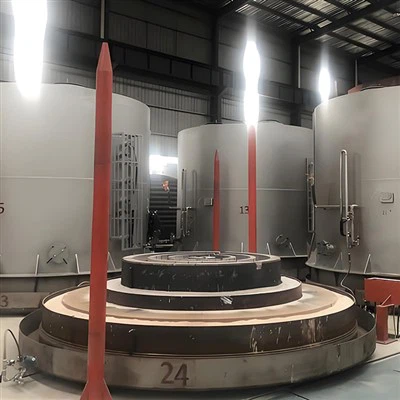
As a supplier of nitriding furnaces, I've witnessed firsthand the pivotal role that control systems play in these specialized heat treatment apparatuses. Nitriding is a thermochemical process used to enhance the surface properties of metals, primarily steels, by diffusing nitrogen into the surface layer. This results in improved wear resistance, hardness, and fatigue life of the treated components. The control system in a nitriding furnace is the brain behind this complex process, ensuring precision, consistency, and safety.
Precision Temperature Control
One of the most critical functions of the control system in a nitriding furnace is temperature regulation. The nitriding process is highly sensitive to temperature variations, as different temperature ranges can lead to distinct microstructural changes in the treated material. For instance, the formation of different nitride phases, such as ε - Fe₂₋₃N and γ' - Fe₄N, is strongly influenced by temperature.
The control system uses advanced sensors, typically thermocouples, to continuously monitor the temperature inside the furnace. These sensors provide real - time feedback to the controller, which then adjusts the heating elements accordingly. Modern control systems are capable of maintaining temperature stability within a very narrow range, often ±1°C or even less. This level of precision is essential for achieving consistent and repeatable nitriding results.
For example, in a Vacuum Nitriding Furnace, precise temperature control is crucial because the process is carried out in a low - pressure environment. Any significant temperature fluctuations can affect the nitrogen diffusion rate and the quality of the nitride layer formed on the workpiece.
Gas Flow and Composition Control
In addition to temperature, the control system also manages the flow and composition of the gas used in the nitriding process. Nitriding can be carried out using various gas mixtures, such as ammonia (NH₃), nitrogen (N₂), and hydrogen (H₂). The ratio of these gases and their flow rates directly impact the nitriding potential and the characteristics of the nitride layer.
The control system regulates the gas flow through mass flow controllers (MFCs). These devices accurately measure and control the flow rate of each gas component. By adjusting the flow rates, the control system can precisely control the nitriding potential, which is a measure of the ability of the gas mixture to nitride the workpiece.
Moreover, the control system can also monitor and adjust the gas composition. For example, in a Nitrogen Protection Copper Bright Annealing Furnace, maintaining the correct gas composition is essential for preventing oxidation of the copper during the annealing process while also facilitating the nitriding reaction.
Process Automation and Monitoring
Another significant role of the control system is to automate the nitriding process. This includes setting up the process parameters, such as temperature, gas flow rates, and process time, and then running the process without continuous manual intervention. Automation not only improves efficiency but also reduces the risk of human error.
The control system can store multiple process recipes, allowing operators to easily select the appropriate recipe for different workpieces or nitriding requirements. Once the recipe is selected, the control system automatically adjusts the furnace settings and monitors the process variables throughout the nitriding cycle.
Real - time monitoring is also a key feature of modern control systems. Operators can view the process parameters, such as temperature, gas flow rates, and pressure, on a graphical user interface (GUI). Alarms can be set to notify operators in case of any abnormal conditions, such as temperature overshoot or gas flow interruption. This enables timely intervention to prevent product defects or equipment damage.
Safety and Interlock Systems
Safety is of utmost importance in any industrial process, and nitriding furnaces are no exception. The control system incorporates various safety features and interlock systems to protect the operators, the equipment, and the environment.


For example, the control system includes over - temperature protection. If the temperature inside the furnace exceeds a pre - set limit, the heating elements are automatically shut off to prevent damage to the furnace and the workpiece. Gas leak detection sensors are also integrated into the control system. In case of a gas leak, the system can shut off the gas supply and activate ventilation systems to remove the leaked gas from the work area.
Interlock systems ensure that certain conditions are met before the furnace can be operated. For instance, the furnace door cannot be opened while the furnace is at a high temperature to prevent burns to the operators. These safety features are essential for maintaining a safe working environment in the heat treatment facility.
Energy Efficiency
In today's industrial landscape, energy efficiency is a major concern. The control system in a nitriding furnace plays a vital role in optimizing energy consumption. By precisely controlling the temperature and gas flow rates, the control system can ensure that the furnace operates at the most energy - efficient level.
For example, modern control systems use advanced algorithms to calculate the optimal heating and cooling profiles. These profiles are designed to minimize energy consumption while still achieving the desired nitriding results. Additionally, the control system can monitor the energy consumption of the furnace and provide data for energy management and cost - analysis.
Impact on Product Quality
The performance of the control system directly impacts the quality of the nitrided products. Precise control of temperature, gas flow, and process time ensures that the nitride layer has the desired thickness, hardness, and microstructure. Consistent product quality is essential for meeting the strict requirements of various industries, such as automotive, aerospace, and tool manufacturing.
For instance, in the automotive industry, nitrided components, such as gears and crankshafts, need to have high wear resistance and fatigue strength. A well - controlled nitriding process, enabled by an advanced control system, can produce components that meet these requirements, leading to improved product reliability and reduced maintenance costs.
Compatibility with Different Furnace Types
As a nitriding furnace supplier, we offer a variety of furnace types, including Ion Nitriding Furnace, vacuum nitriding furnaces, and gas nitriding furnaces. The control system is designed to be compatible with different furnace designs and operating principles.
Each type of furnace has its own unique requirements for temperature, gas flow, and electrical parameters. The control system can be customized to meet these specific requirements, ensuring optimal performance of the furnace. For example, an ion nitriding furnace requires precise control of the electrical discharge parameters in addition to temperature and gas flow. The control system can manage these complex parameters to achieve efficient and high - quality ion nitriding.
Conclusion
In conclusion, the control system is an integral part of a nitriding furnace, playing a multifaceted role in ensuring precision, consistency, safety, and energy efficiency. It enables the nitriding process to be carried out with a high degree of accuracy, resulting in high - quality nitrided products.
As a supplier of nitriding furnaces, we understand the importance of providing advanced control systems that meet the evolving needs of our customers. Whether you are looking for a Nitrogen Protection Copper Bright Annealing Furnace, a Vacuum Nitriding Furnace, or an Ion Nitriding Furnace, our control systems are designed to deliver optimal performance.
If you are interested in learning more about our nitriding furnaces and the advanced control systems they incorporate, or if you have specific requirements for your heat treatment process, we encourage you to contact us for a detailed discussion. Our team of experts is ready to assist you in selecting the right furnace and control system for your application.
References
- ASM Handbook, Volume 4: Heat Treating, ASM International.
- "Nitriding and Nitrocarburizing" by O. D. Sherby and J. Wadsworth, Springer - Verlag.
- Industrial Heating Equipment Standards, published by relevant industry associations.