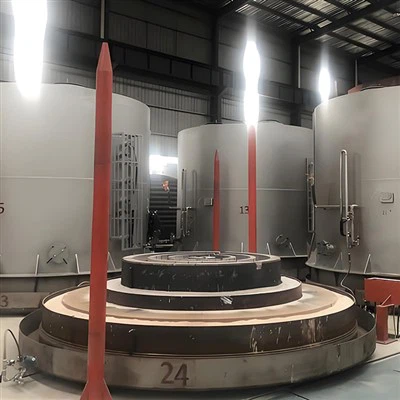
Hey there! As a supplier of nitriding furnaces, I've seen firsthand how these amazing pieces of equipment can have a huge impact on the magnetic properties of metals. In this blog, I'm gonna break down how a nitriding furnace works and how it changes the magnetic traits of different metals.
First off, let's talk about what nitriding is. Nitriding is a heat - treating process where nitrogen is introduced to the surface of a metal. This is done in a nitriding furnace, which can come in different types like the Pit Type Nitriding Furnace and the Vacuum Nitriding Furnace. The goal of nitriding is to improve the metal's surface hardness, wear resistance, and fatigue life. But it also has some interesting effects on the magnetic properties.
Now, metals have different magnetic behaviors. Some are ferromagnetic, like iron, nickel, and cobalt. These metals can be magnetized and have a strong response to magnetic fields. Others are paramagnetic, which means they're weakly attracted to magnetic fields, and diamagnetic, which are weakly repelled.
When we put a metal in a nitriding furnace, the nitrogen atoms diffuse into the metal's surface. This forms a nitride layer. The formation of this layer can change the crystal structure of the metal. For ferromagnetic metals, this change in crystal structure can alter the magnetic domain structure. Magnetic domains are small regions in the metal where the magnetic moments of the atoms are aligned in the same direction.
In a nitriding furnace, the diffusion of nitrogen can create stress in the metal. This stress can influence the movement and alignment of magnetic domains. For example, the stress might pin the domain walls, making it harder for them to move. When domain walls are harder to move, the metal becomes more difficult to magnetize and demagnetize. This means that the coercivity, which is the amount of magnetic field needed to reduce the magnetization of the metal to zero, increases.
Let's take iron as an example. Iron is a well - known ferromagnetic metal. When iron is nitrided in a furnace, the nitrogen atoms react with the iron to form iron nitrides. These nitrides have different magnetic properties compared to pure iron. The iron nitrides can have a higher magnetic anisotropy, which is the property that makes a material more likely to be magnetized in a certain direction.
Another aspect is the effect on the saturation magnetization. Saturation magnetization is the maximum magnetization that a metal can reach in a strong magnetic field. In some cases, the formation of the nitride layer can reduce the saturation magnetization. This is because the nitrogen atoms can disrupt the alignment of the magnetic moments of the metal atoms.
For paramagnetic and diamagnetic metals, the effect of nitriding is a bit different. Since these metals have weaker magnetic responses to begin with, the changes might be more subtle. However, the introduction of nitrogen can still change the electronic structure of the metal. This can lead to small changes in the magnetic susceptibility, which is a measure of how easily a material can be magnetized in a magnetic field.
The type of nitriding furnace used also plays a role. A Pit Type Nitriding Furnace is often used for large - scale and deep - nitriding applications. In this type of furnace, the metal is immersed vertically in the nitriding atmosphere. The slow and uniform diffusion of nitrogen in a pit - type furnace can result in a more controlled change in the magnetic properties.
On the other hand, a Vacuum Nitriding Furnace offers a cleaner environment. The absence of oxygen and other contaminants can lead to a more precise nitriding process. This can be crucial when we want to achieve specific changes in the magnetic properties of the metal.
We also have the Nitrogen Protection Copper Bright Annealing Furnace. Although it's mainly for annealing copper with nitrogen protection, it can also have some side - effects on the magnetic properties if the copper has any ferromagnetic impurities.
The temperature and time in the nitriding furnace are critical factors. Higher temperatures generally lead to faster nitrogen diffusion. But if the temperature is too high, it can cause excessive grain growth in the metal. This can have a negative impact on both the mechanical and magnetic properties. The time in the furnace also matters. Longer nitriding times allow for more nitrogen to diffuse into the metal, but it also increases the risk of over - nitriding, which can lead to brittleness and other issues.
In industrial applications, understanding how a nitriding furnace affects the magnetic properties of metals is very important. For example, in the manufacturing of electrical transformers and motors, the magnetic properties of the core materials need to be carefully controlled. If the coercivity or saturation magnetization of the core metal changes too much due to nitriding, it can affect the efficiency and performance of the device.
So, if you're in an industry where the magnetic properties of metals are crucial, and you're looking for a reliable nitriding furnace, we've got you covered. Whether you need a Pit Type Nitriding Furnace for large - scale production or a Vacuum Nitriding Furnace for high - precision work, we can provide the right solution. Our furnaces are designed to give you precise control over the nitriding process, ensuring that you get the desired changes in the metal's magnetic properties while maintaining its mechanical integrity.
If you're interested in learning more or want to discuss your specific requirements, don't hesitate to reach out. We're here to help you make the most of the nitriding process and get the best results for your metal products.
References


- Cullity, B. D., & Graham, C. D. (2008). Introduction to Magnetic Materials. Wiley.
- ASM Handbook Volume 4: Heat Treating. ASM International.