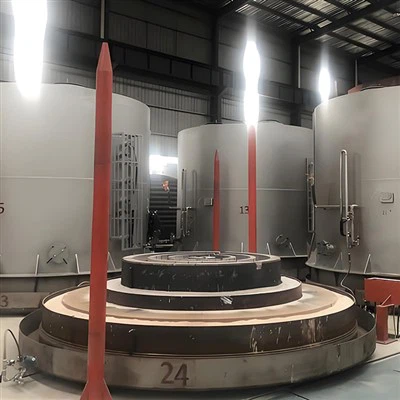
Hey there! As a supplier of Ion Nitriding Furnaces, I often get asked whether an Ion Nitriding Furnace can improve the hardness of materials. Well, the short answer is yes, and in this blog, I'm gonna dive deep into how it works, the benefits, and why it's a game - changer in the materials industry.
Let's start with the basics. Ion nitriding, also known as plasma nitriding, is a surface - hardening heat treatment process. In an Ion Nitriding Furnace, the material to be treated is placed inside a vacuum chamber. The chamber is then filled with a nitrogen - containing gas, usually a mixture of nitrogen and hydrogen.
Once the chamber is sealed and the gas is introduced, a high - voltage direct current is applied between the material (which acts as the cathode) and the furnace walls (which act as the anode). This creates a plasma, a highly ionized gas. The nitrogen ions in the plasma are accelerated towards the surface of the material by the electric field. When these ions hit the material's surface, they penetrate the top layers and react with the atoms in the material to form nitrides.
These nitrides are extremely hard compounds. For example, iron nitrides can have a hardness that is significantly higher than that of the base iron material. By forming a layer of these hard nitrides on the surface of the material, the overall hardness of the material is greatly improved.
One of the main advantages of using an Ion Nitriding Furnace for hardness improvement is the precision. Unlike some other heat - treatment methods, ion nitriding allows for very precise control over the depth and composition of the nitride layer. You can adjust the process parameters such as the gas mixture, the voltage, and the treatment time to get exactly the hardness and layer thickness you need for your specific application.
Another benefit is the low - temperature nature of the process. Ion nitriding typically takes place at temperatures between 400°C and 600°C. This is much lower than the temperatures used in some other heat - treatment processes like carburizing, which can be as high as 900°C or more. The lower temperature means that there is less distortion of the material. This is crucial for parts that require tight dimensional tolerances, such as gears, shafts, and molds.
Let's talk about some real - world applications. In the automotive industry, Ion Nitriding Furnaces are used to treat engine components like crankshafts and camshafts. By improving the hardness of these parts, their wear resistance is increased, which leads to a longer service life and better performance. In the tool - making industry, ion nitriding is used to treat cutting tools such as drills, end mills, and dies. The harder surface allows these tools to cut more efficiently and last longer before they need to be replaced.
Now, you might be wondering how an Ion Nitriding Furnace compares to other types of nitriding furnaces. Well, let's take a look at the Nitrogen Protection Copper Bright Annealing Furnace. This type of furnace is mainly used for annealing copper materials under a nitrogen atmosphere to achieve a bright surface finish. While it can also have some impact on the material's properties, its primary function is not hardness improvement like an Ion Nitriding Furnace.
On the other hand, the Vacuum Nitriding Furnace is also used for nitriding, but it works a bit differently. In a vacuum nitriding furnace, the material is heated in a vacuum environment and then nitrogen gas is introduced. The nitriding process here is based on diffusion rather than the ion - bombardment mechanism used in an Ion Nitriding Furnace. The Ion Nitriding Furnace generally offers better control and faster processing times compared to a vacuum nitriding furnace in many cases.
When it comes to the cost - effectiveness of using an Ion Nitriding Furnace for hardness improvement, it's actually quite good in the long run. Sure, the initial investment in the furnace and the setup might be significant. But when you consider the savings from reduced tool wear, longer part life, and less scrap due to distortion, the return on investment can be very high.
In addition to improving hardness, ion nitriding also enhances other properties of the material. For example, it can improve the corrosion resistance of the material. The nitride layer acts as a barrier, preventing corrosive agents from reaching the base material. It can also improve the fatigue resistance, which is important for parts that are subjected to cyclic loading.


If you're in an industry where hardness, wear resistance, and dimensional stability are crucial, an Ion Nitriding Furnace could be the solution you've been looking for. Whether you're in the manufacturing of automotive parts, aerospace components, or high - precision tools, this technology can give you a competitive edge.
So, if you're interested in learning more about how an Ion Nitriding Furnace can improve the hardness of your materials and meet your specific production needs, don't hesitate to reach out. We're here to help you understand the process, choose the right equipment, and get the most out of your investment.
In conclusion, an Ion Nitriding Furnace is a powerful tool for improving the hardness of materials. Its precision, low - temperature operation, and ability to enhance multiple properties make it a top choice in many industries. If you're considering upgrading your heat - treatment capabilities, I highly recommend giving ion nitriding a closer look.
References
ASM Handbook Volume 4: Heat Treating, ASM International
"Surface Engineering for Corrosion and Wear Resistance" by David Rickerby and Andrew Mathews