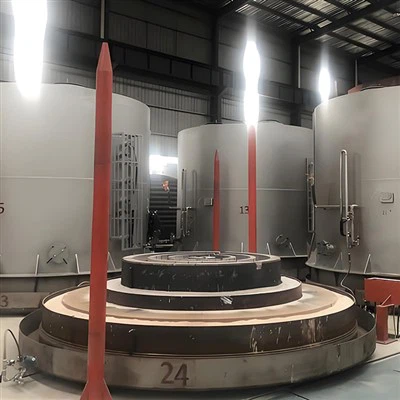
Hey there! As a supplier of Box Annealing Furnaces, I've been getting a lot of questions lately about how furnace pressure affects the annealing process. So, I thought I'd dive into this topic and share some insights with you all.
First off, let's quickly go over what annealing is. Annealing is a heat treatment process used to reduce hardness, increase ductility, and relieve internal stresses in materials. A Box Annealing Furnace is a popular choice for this process because it provides a controlled environment for the material to be heated and cooled.
Now, let's talk about furnace pressure. The pressure inside a Box Annealing Furnace can have a significant impact on the annealing process. There are two main types of pressure conditions we usually deal with: atmospheric pressure and vacuum pressure.
Atmospheric Pressure Annealing
When annealing at atmospheric pressure, the furnace is open to the surrounding air. This is the simplest and most common way of annealing in a Box Annealing Furnace. The main advantage of this method is its simplicity and low cost. You don't need any special equipment to create a vacuum, and the furnace can be easily loaded and unloaded.
However, there are also some drawbacks. One of the biggest issues is oxidation. When the material is heated in the presence of oxygen, it can form an oxide layer on its surface. This oxide layer can affect the material's properties and appearance. For example, in the case of metals, it can lead to a loss of shine and a decrease in corrosion resistance.
Another problem with atmospheric pressure annealing is the presence of impurities in the air. These impurities can react with the material during the annealing process, causing defects and reducing the quality of the final product.
Vacuum Pressure Annealing
To overcome the problems associated with atmospheric pressure annealing, many manufacturers opt for vacuum annealing. In a vacuum annealing process, the air inside the furnace is removed, creating a low-pressure environment. This significantly reduces the chances of oxidation and contamination.
When you use a Vacuum Annealing Furnace, you can achieve a much higher quality of annealing. The material remains clean and free from oxide layers, which is especially important for applications where surface finish and purity are critical. For example, in the electronics industry, vacuum annealing is often used to treat semiconductor materials to ensure their optimal performance.
But vacuum annealing also has its challenges. The equipment required to create and maintain a vacuum is more complex and expensive than a standard atmospheric pressure furnace. There are also strict requirements for sealing the furnace to prevent air leakage. Additionally, the process of evacuating the furnace takes time, which can increase the overall annealing cycle time.
Bell Type Annealing Furnace and Pressure
Another type of annealing furnace that's worth mentioning is the Bell Type Annealing Furnace. This furnace consists of a bell-shaped cover that can be placed over the material to be annealed. The pressure inside a Bell Type Annealing Furnace can also vary depending on the process requirements.
In some cases, a controlled atmosphere can be introduced into the bell to prevent oxidation. This can be an inert gas like nitrogen or argon. By controlling the pressure and composition of the atmosphere inside the bell, you can achieve a more precise annealing process.
Rapid Annealing Furnace and Pressure
The Rapid Annealing Furnace is designed to heat the material very quickly and then cool it rapidly. Pressure also plays an important role in this process. A proper pressure environment can help to ensure that the material is heated and cooled evenly, which is crucial for achieving the desired material properties.
In a rapid annealing process, a high-pressure environment can sometimes be used to enhance heat transfer. This allows the material to reach the annealing temperature faster, reducing the overall processing time. However, this also requires careful control to prevent overheating or other issues.


How to Choose the Right Pressure for Your Annealing Process
So, how do you decide whether to use atmospheric pressure, vacuum pressure, or some other pressure condition for your annealing process? Well, it depends on several factors.
First, consider the material you're annealing. Some materials are more prone to oxidation than others. For example, metals like steel and copper are relatively easy to oxidize, so vacuum annealing might be a better choice for these materials. On the other hand, if you're annealing a material that's not very sensitive to oxidation, atmospheric pressure annealing could be sufficient.
Second, think about the application of the final product. If the product requires a high-quality surface finish and high purity, vacuum annealing is likely the way to go. But if the surface finish is not a critical factor and cost is a major concern, atmospheric pressure annealing might be more suitable.
Finally, consider your production volume and budget. Vacuum annealing equipment is more expensive and requires more maintenance than atmospheric pressure furnaces. If you have a large production volume and can afford the investment, vacuum annealing can offer long-term benefits in terms of product quality. But if you're a small-scale manufacturer or have a limited budget, atmospheric pressure annealing might be a more practical option.
Conclusion
In conclusion, furnace pressure has a profound influence on the annealing process in a Box Annealing Furnace. Whether you choose atmospheric pressure, vacuum pressure, or some other pressure condition depends on the material, the application, and your production requirements.
As a Box Annealing Furnace supplier, we understand the importance of providing the right solution for your annealing needs. We can help you choose the most suitable furnace and pressure condition based on your specific requirements.
If you're interested in learning more about our Box Annealing Furnaces or have any questions about the annealing process, feel free to reach out to us. We're always happy to have a chat and discuss how we can help you achieve the best results in your annealing operations.
References
- Smith, J. (2018). Heat Treatment Handbook. New York: Wiley.
- Jones, A. (2020). Advanced Annealing Techniques. London: Elsevier.